

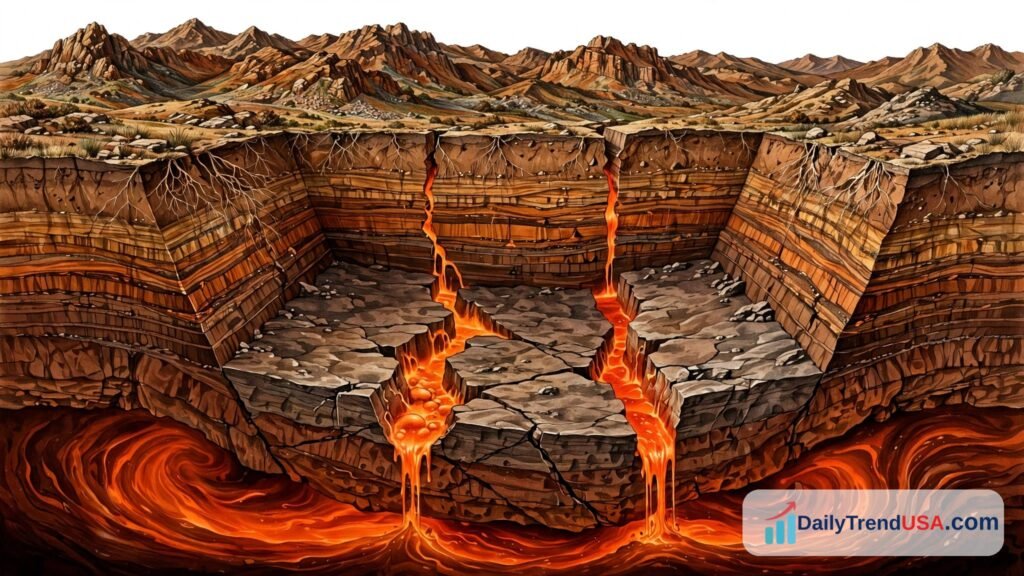
Standfirst: Deep beneath the mountains of southeastern Iran, a tectonic plate is tearing apart. Scientists have found two giant tears in the Arabian Plate, one running sideways and one running up and down, in a region where an ancient ocean is vanishing and two continents are colliding. The discovery, published in the journal Nature Geoscience on November 4, 2026, gives researchers a rare look at a process that usually takes millions of years and leaves almost no trace.
Key facts
| Fact | Detail |
|---|---|
| What was found | Two tears in the Arabian Plate beneath southeastern Iran |
| Where | The Zagros-Makran transition zone, where the Zagros collision zone meets the Makran subduction zone |
| Published | Nature Geoscience, November 4, 2026 (Lan and colleagues) |
| Research team | Led by the Chinese Academy of Sciences |
| How it was found | 69 seismic stations recording vibrations from distant earthquakes, March 2017 to September 2018 |
| Oceanic slab depth | At least 450 kilometers in the Makran subduction zone |
| Continental slab depth | No deeper than 300 kilometers in the Zagros collision zone |
| What happens next | Models suggest the two tears will eventually join together |
What the team found
Researchers led by a team from the Chinese Academy of Sciences found extensive evidence of two giant tears in a tectonic plate called the Arabian Plate, underneath southeastern Iran. The findings appear in a new study in Nature Geoscience titled “Seismic evidence for double slab tears at the Neo-Tethyan subduction-collision transition.”
The tears sit in a place where two very different kinds of plate movement meet. To the east, in the Makran subduction zone, the plate is sliding down into the Earth. To the west, in the Zagros collision zone, it is crashing into another plate and building mountains. The boundary between those two zones is where the damage shows up.
The larger tear runs horizontally along that boundary. It has detached a sunken piece of oceanic slab from the continental slab above it. The second tear is smaller and runs vertically, closer to the surface, near the Makran Trench, and it separates the oceanic and continental parts of the plate along the boundary.
Seeing both kinds of tearing at the same time, in the same place, is very unusual. Geologists have seen each type on its own in other parts of the world, but catching both together is rare. That is what makes this study stand out.
Why the plate is tearing
The tears are being caused by different rock densities. One part of the Arabian Plate is an oceanic slab that was once part of the ancient Neo-Tethys Ocean. Its basalt rock is heavier and thinner, and it is being pushed down under a neighboring plate in a process called subduction.
The other part of the plate is continental rock. It is thicker but less dense, with lighter ingredients that make it granite-like. This rock resists being pushed underground. Instead of sinking, it piles up and forms mountains when it hits resistance.
That mismatch is what is causing the ruptures. The heavy oceanic slab keeps sinking, while the lighter continental slab holds back. The plate is being pulled in two directions at once, and it is tearing along the line where the two kinds of rock meet.
The second, vertical tear has a different cause. The researchers say it probably started at the junction between the Makran Trench and a transform boundary, and it has spread southward as the continental plate moves northward. So the two tears began independently, for different reasons, in the same region.
How scientists saw it
Nobody drilled or dug to find the damage. Instead, the team listened. A network of 69 seismic monitoring stations recorded vibrations from distant earthquakes over about a year and a half, from March 2017 to September 2018.
Those vibrations change speed depending on the temperature and density of the rock they pass through. By measuring how the waves arrived at each station, the team built a tomographic model, a kind of three-dimensional scan of the rock hundreds of kilometers below the surface.
The picture that came back was clear. In the Makran subduction zone, the oceanic lithosphere has sunk continuously to depths of at least 450 kilometers. In the Zagros collision zone to the west, the continental lithosphere has sunk no deeper than 300 kilometers. The gap between those two depths is where the plate is tearing apart.
The study authors put it this way in their paper: “We show that in the Makran subduction zone, the oceanic lithosphere has continuously subducted to depths of at least 450 km, whereas in the Zagros collision zone to the west, the continental lithosphere has subducted no deeper than 300 km, resulting in east-southward slab tearing and detachment.”
The two tears, side by side
The horizontal tear is the bigger of the two. It sits where the Zagros collision zone meets the Makran subduction zone, and it runs east to south as the sinking slab pulls away from the part that is stuck. The researchers describe it as a detachment: a sunken fragment of oceanic slab has broken free from the continental slab above it.
The vertical tear is smaller and closer to the surface, near the Makran Trench. It separates the oceanic and continental plates along the plate boundary, and it is driven more by the movement of the plates than by the difference in rock density.
The study models suggest the tears have been growing for several million years. They are not new, and they are not sudden. They are the slow result of the Arabian Plate pushing northward into Eurasia, a collision that has built the Zagros Mountains and is still going on today.
What is new is that scientists can now see them. Until this seismic survey, the structure hundreds of kilometers down was mostly guesswork, filled in from computer models and from what could be measured at the surface.
What happens next
According to the study models, the two tears will eventually join. The researchers write that while the two tears start independently, the strip of continental and oceanic rock between them is gradually consumed as the tearing advances, and this progressive linkage is expected to eventually drive the two tears to merge into one.
That merger will not happen on any human timescale. The process has already taken millions of years, and it will take millions more. Nobody alive today will see the tears meet, but geologists can now watch the early stages of a process that reshapes continents.
The next question is how the tears, and their possible merging, might affect volcanic activity in the region. Hot magma already appears to be filling some of the gaps left by the ruptures. The researchers plan to keep studying how that magma moves and whether it could feed future volcanoes in southeastern Iran.
Why it matters
The discovery matters because it captures a key moment in the life cycle of an ocean. Scientists call that cycle the Wilson Cycle: oceans open up, widen, and then gradually close again as tectonic plates move around. The transition from oceanic subduction to continental collision is one of its most important stages, and one of the least observed.
“The transition from oceanic subduction to continental collision is a key stage in the Wilson Cycle,” the researchers write. “Yet, key processes governing this transition remain unclear owing to sparse observations of structure at depth.”
The paper adds: “The coexistence of these two tearing modes provides a rare snapshot of the short-lived early transition from oceanic subduction to continental collision.” In plain terms, the team caught a fleeting moment in Earth’s history, one that usually passes without leaving a clear record.
It is also a reminder that the ground under our feet is not fixed. The Zagros Mountains are still rising, the Arabian Plate is still moving north, and the ocean that once separated Arabia from Eurasia is in its final stages of disappearing. This study shows that ending in detail for the first time.
Daily Trend USA has covered other recent science findings, including a possible new dwarf planet found beyond Pluto and the Webb telescope’s look at the dusty ice of interstellar comet 3I/ATLAS. This week also brought other Earth science news, including an unusually early weakening of the polar vortex.
What we know
- Two tears exist in the Arabian Plate beneath southeastern Iran, confirmed by seismic imaging published in Nature Geoscience on November 4, 2026.
- The larger tear is horizontal, at the junction of the Zagros collision zone and the Makran subduction zone. The smaller tear is vertical, near the Makran Trench.
- The oceanic slab has sunk to at least 450 kilometers in Makran, while the continental slab has sunk no deeper than 300 kilometers in Zagros.
- The tears were found using 69 seismic stations that recorded distant earthquakes between March 2017 and September 2018.
- Models suggest the tears have grown over several million years and will eventually merge.
What we don’t know
- How the tears and their eventual merging will affect volcanic activity in the region, though hot magma already appears to be filling some of the gaps.
- Exactly when the tears began, beyond the model estimate of several million years ago.
- Whether the merging of the tears will change earthquake patterns in southeastern Iran. The study does not make any prediction about earthquake risk.




2 Comments