


Standfirst: Thanksgiving falls on Thursday, November 26, and the turkey is the center of the meal. Thanksgiving food safety comes down to three steps from the U.S. Department of Agriculture: thaw the bird the safe way, cook it to 165 degrees F, and get leftovers into the fridge within two hours. This guide walks through each step in plain order.
Key facts
| Fact | Detail |
|---|---|
| Thanksgiving | Thursday, November 26, 2026 |
| Thawing | About 24 hours in the fridge for every 4 to 5 pounds |
| Cooking temperature | 165 degrees F in the breast, wing and thigh |
| Oven setting | No lower than 325 degrees F |
| Danger zone | Between 40 and 140 degrees F |
| Leftovers | Into the fridge within 2 hours, use within 3 to 4 days |
| Reheating | Back to 165 degrees F |
| Help | USDA Meat and Poultry Hotline, 1-888-674-6854 |
Start with the thaw, days before the meal
Thawing is the longest part of the job and the easiest to get wrong, so it comes first on the calendar. The USDA gives three safe ways to thaw a turkey: in the refrigerator, in cold water, or in the microwave. A frozen turkey should never be thawed on the counter or in hot water. The outside of the bird can warm into the danger zone, between 40 and 140 degrees F, where bacteria grow fast, while the center is still frozen solid.
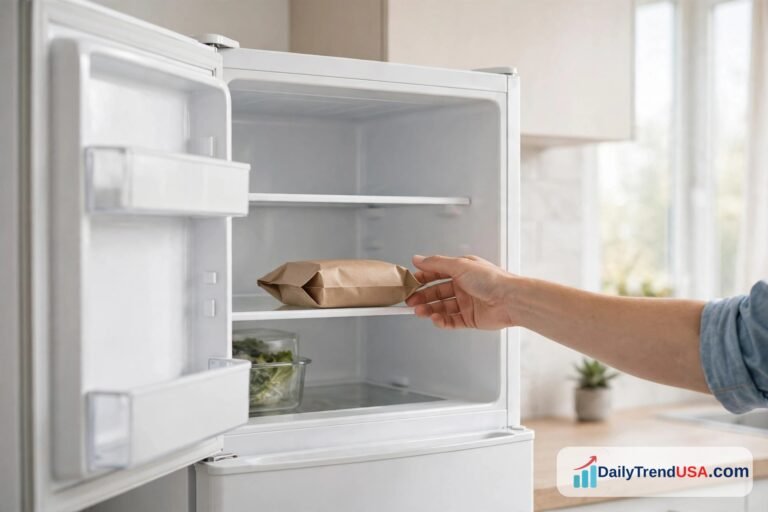
The refrigerator is the best option because it is the most forgiving. The USDA says to allow about 24 hours for every 4 to 5 pounds of turkey, with the fridge set at 40 degrees F or below. Keep the bird in its wrapper on a tray, on a low shelf, so juices cannot drip onto other food. A turkey thawed this way can stay in the fridge for one to two more days before cooking, and it may be refrozen if plans change.
The USDA thawing table runs like this:
- 4 to 12 pounds: 1 to 3 days
- 12 to 16 pounds: 3 to 4 days
- 16 to 20 pounds: 4 to 5 days
- 20 to 24 pounds: 5 to 6 days
A 16-pound turkey takes about four days, so for Thanksgiving on Thursday, November 26, it should go into the fridge on Sunday, November 22. A 20-pound bird needs five days, so it should start thawing on Saturday, November 21. Count back from your own bird’s weight and mark the day on the calendar now, while there is still time.
If the bird is still frozen and the meal is close, cold water is the faster safe method. Put the turkey in its wrapper in a clean sink or large container, cover it with cold water, and change the water every 30 minutes. A turkey thawed in cold water must be cooked as soon as it is thawed, and it should not be refrozen. The microwave can also work for a small bird, but the USDA says to follow the microwave maker’s guide and cook the turkey right away.
Cook it to 165 degrees, and check in three places
Once the turkey is thawed, the number that matters is 165 degrees F. The USDA says a whole turkey is safe when it reaches a minimum internal temperature of 165 degrees F, checked with a food thermometer in three places: the thickest part of the breast, the innermost part of the wing, and the innermost part of the thigh. All three spots must reach 165 degrees. Color is not a reliable guide. Pink meat can be safe and brown meat can be undercooked, so the thermometer is the only way to know.
Set the oven to at least 325 degrees F. The USDA says slow-cooking below that temperature is unsafe, because the bird spends too long in the danger zone. Put the turkey on a rack in a shallow roasting pan, so heat can reach it from all sides. Roasting times at 325 degrees run from about 2 and 3/4 to 3 hours for an 8 to 12 pound bird, up to 4 and 1/2 to 5 hours for a 20 to 24 pound bird, but times are only a guide. The thermometer reading is what counts.
Two habits are worth dropping. Do not wash the raw turkey. Washing spreads germs around the sink and kitchen in tiny water drops, and it does not make the bird safer. Cooking does that. And cook stuffing in its own dish rather than inside the bird. Stuffing cooked inside the turkey must also reach 165 degrees all the way through, which is hard to check and easy to miss.
Handle the sides with the same care
The turkey gets the attention, but the rest of the meal follows the same rules. Keep hot food hot and cold food cold. Perishable dishes should not sit at room temperature for more than two hours, or more than one hour if the room is above 90 degrees F. That two-hour clock starts when the food is served, not when the meal ends.
Wash hands often while cooking, and wash them after touching raw turkey. Keep raw meat away from ready-to-eat food, and use separate cutting boards and knives for the raw bird and for anything that will not be cooked. A clean kitchen towel is not a substitute for washing. Change dish towels often during a long cooking day, and wipe counters with hot, soapy water after raw meat has touched them.
Leftovers: the two-hour rule
Food safety does not end when the turkey is carved. The USDA says to throw away any turkey, stuffing or gravy left out at room temperature for longer than two hours, or longer than one hour when it is above 90 degrees F. Bacteria that cause foodborne illness cannot be smelled or tasted, so the sniff test is not a safety test. If food has sat out too long, it should go in the trash.
Pack leftovers into the fridge within two hours of serving. Divide them into small, shallow, covered containers so they cool fast, and cut leftover turkey into smaller pieces for the same reason. Use refrigerated turkey and stuffing within 3 to 4 days, and use gravy within 1 to 2 days. That means leftovers from a Thursday meal should be eaten or frozen by Monday. Frozen leftovers keep their best quality for 2 to 6 months.
When it is time to eat them again, reheat leftovers to 165 degrees F, checked with a food thermometer in several spots. Bring gravy to a rolling boil. A microwave can leave cold spots, so stir food and turn it during reheating, and let it stand for a minute before eating.
When to ask for help
The USDA runs a Meat and Poultry Hotline at 1-888-674-6854, staffed on weekdays, and it answers food safety questions from home cooks. The USDA also publishes a free thawing calculator and a safe Thanksgiving guide online, with the same times and temperatures in this article.
A safe Thanksgiving meal takes planning, not luck. Start the thaw on time, cook to 165 degrees in all three places, and get the leftovers into the fridge within two hours. Those three habits cover the whole day, from the freezer to the last sandwich.
Related reading: For more food safety, see our guide on how to check if your kitchen is affected by a food recall, our report on Brad’s kale chips recalled over a possible thallium risk, and our report on the BetterBallen frozen snacks public health alert.
Sources
U.S. Department of Agriculture, Food Safety and Inspection Service, “Turkey Basics: Safe Thawing” and “Your Safe Thanksgiving Guide” (updated November 5, 2026); Centers for Disease Control and Prevention, “Preparing Your Holiday Turkey Safely”; U.S. Food and Drug Administration, “Are You Storing Food Safely?” This article gives general food safety information, not medical advice.



6 Comments