

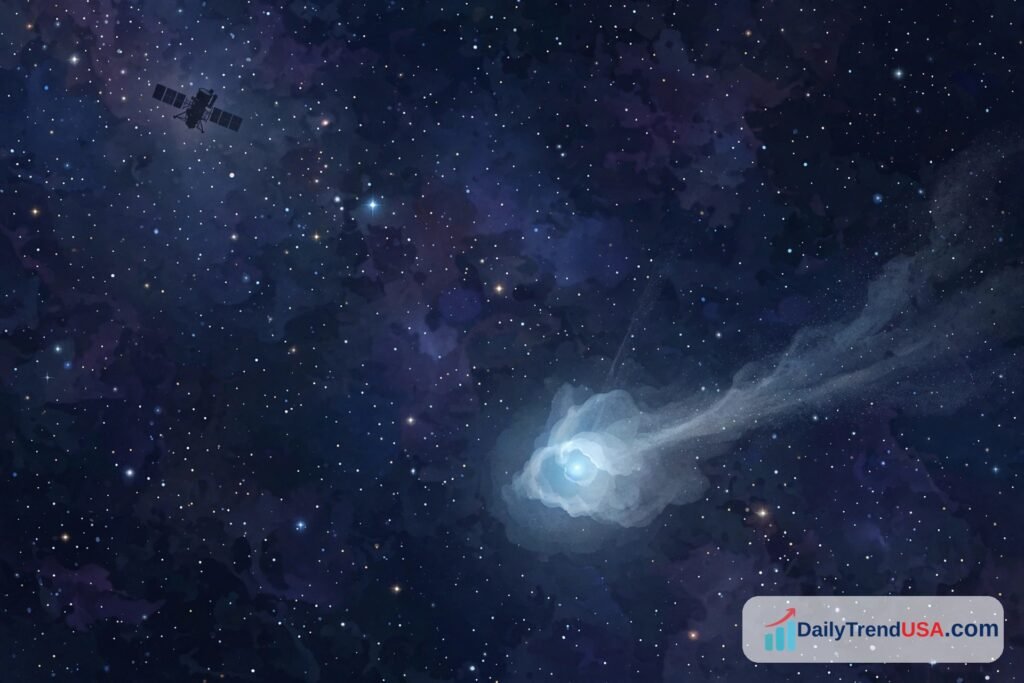
NASA’s James Webb Space Telescope studied only the third visitor ever found from another star system, and its ice grains look strange at first — until scientists compared them with icy worlds beyond Neptune. The grains are tiny, about a micron across, and they are rich in dust. Here is what the research actually found, and what it does not prove.
What we know / What we don’t know
What we know:
- 3I/ATLAS is only the third interstellar object ever confirmed in our solar system, after 1I/’Oumuamua in 2017 and 2I/Borisov in 2019.
- Webb watched it three times — in August 2025, December 2025, and April 2026 — before and after its closest pass by the Sun.
- Its water ice looks different from most comets we know: one strong ice signal is present, but two weaker signals are faint or missing.
- The best explanation is dust-rich ice grains about a micron or smaller — far thinner than a human hair — mixed with rocky dust.
- That ice pattern resembles some icy worlds beyond Neptune, suggesting planet-building material may work in similar ways around other stars.
What we don’t know:
- Whether 3I/ATLAS is typical of interstellar comets, or an unusual case. Scientists say more visitors are needed to tell.
- Why the grains seemed to change by the final observation in April 2026 — heating by the Sun and newly exposed material are both possible.
- Which star it came from. Its home system has not been identified, and its exact age has not been directly measured.
- Whether the pattern holds for other interstellar visitors. Webb observations of our own comets and future visitors will test the idea.
A visitor from another star
On July 1, 2025, a survey telescope in Chile spotted something moving in a way no local comet should move. The object, found by the Asteroid Terrestrial-impact Last Alert System (ATLAS), was on a strongly stretched-out path that is not tied to the Sun. That is the key clue: unlike the comets that orbit our Sun again and again, 3I/ATLAS was just passing through. It came from the space between stars, swung around the Sun, and is now heading back out. It will not return.
Its official name is C/2025 N1, but almost everyone calls it 3I/ATLAS. The “3I” simply means it is the third interstellar object confirmed. The first, ‘Oumuamua, was found in 2017. The second, Borisov, followed in 2019. Each one is a rare chance to study material that formed around a different star, without ever leaving home.
Three visits, one puzzle
Webb observed 3I/ATLAS with its Near-Infrared Spectrograph, an instrument that splits light into its component colors to reveal what a distant object is made of. The three visits happened on August 6, 2025, December 22, 2025, and April 1, 2026. At those times the comet sat about 3.3, 2.4, and 5.7 times as far from the Sun as Earth is. Its closest approach to the Sun came on October 29, 2025, at about 1.36 times the Earth-Sun distance — just inside the orbit of Mars.
As the comet warmed up near the Sun, gas escaping from inside it carried tiny ice and dust grains into the cloud around its nucleus, called the coma. Webb read the light from those grains, and the result was a puzzle.
Water ice leaves clear fingerprints in infrared light. It normally shows a deep dip near 3 microns, plus two weaker dips near 1.5 and 2.0 microns. Most icy comets show all three. In 3I/ATLAS, the 3-micron dip was strong, but the two weaker dips were very weak or missing.
“That combination was a puzzle,” said lead author Dr. Silvia Protopapa of the Southwest Research Institute (SwRI). “The strong 3-micron band points to water ice in the coma. But the weak or absent shorter-wavelength bands suggest the ice is not in the form we usually see in solar system comets.”
Tiny grains, lots of dust
The team tested the spectra against computer models of how light scatters off grains of different sizes and makeups. The best match was surprising in its simplicity: grains about a micron or smaller — a micron is one-thousandth of a millimeter — made of water ice mixed with dust.
In grains that small and dusty, light only travels a short distance through the ice. That weakens the shorter-wavelength signals while leaving the strong 3-micron signal standing. Ice grains in other comets are about the same size, but they are thought to be fairly pure ice, perhaps with only a little dust mixed in.
“The grains of 3I/ATLAS are about the same size as those in our own comets,” Protopapa said. “What seems to set them apart is how much dust is mixed into the ice.”
The grains also seemed to change over time. By the final observation in April 2026, as the comet moved away from the Sun, the data favored an extra group of more ice-rich grains. Scientists cannot yet say why. One idea is that the Sun heated the grains differently at each visit. Another is that the comet’s surface wore away near the Sun and exposed fresher material underneath. “Both are possible, and telling them apart is one of the open questions we aim to address,” said Dr. Michael Kelley of the University of Maryland, the paper’s second author.
A familiar pattern beyond Neptune
The most striking part of the study came next. When the team compared 3I/ATLAS with Webb spectra of trans-Neptunian objects — icy bodies that orbit beyond Neptune and are thought to preserve material from the early solar system — the match was close. The shape of the 3-micron water-ice band in 3I/ATLAS resembled several groups of those distant worlds, especially ones that also show carbon dioxide ice and organic compounds. Like 3I/ATLAS, those objects lack strong 1.5- and 2.0-micron water-ice bands. Readers who want more on distant icy worlds can read our earlier explainer on a possible new dwarf planet found beyond Pluto.
That resemblance is about the water-ice signal only. It does not mean the comet formed in our solar system, and it does not mean all of its ingredients match those distant worlds. But it does point to a bigger idea: the small icy building blocks of planets, called planetesimals, may share a common range of properties whether they form here or around another star.
“At first glance, 3I/ATLAS looks different from the icy comets we know,” Protopapa said. “But when we placed it alongside distant icy worlds in our own solar system, it no longer looked out of place. This suggests that the icy building blocks of planets, here and around other stars, may share ice in the form of tiny, micron-scale grains, ranging from relatively pure ice to ice mixed with dust, with 3I/ATLAS toward the dusty end.”
If that idea holds up, it would mean the physical form of water ice is set early, in the disks of gas and dust where planets form, and is at least partly preserved in the icy bodies that grow from those disks. That is a claim about how planet formation works in general — not just in our solar system.
A second clue: heavy methane
A separate Webb study, published in Nature Astronomy, looked at a different part of the comet’s chemistry: its methane. Methane is a simple gas, and most of its hydrogen is the ordinary light kind. A rare heavy form, called deuterium, carries an extra neutron. The study found that the methane leaving 3I/ATLAS had a deuterium-to-hydrogen ratio of about 3.18 percent — roughly 13 times the value measured in the methane of comet 67P by the Rosetta spacecraft, and higher than any organic molecule measured in our solar system.
The researchers read that as a sign of ice that formed in a cold cloud poor in heavy elements, consistent with isotope evidence pointing to a very old origin. Some headlines turned that into a simple age, such as “10 billion years old.” Readers should be careful here: the methane paper does not directly measure an age of 10 billion years. The age range is an interpretation drawn from isotope evidence, not a number the telescope read off the comet. What the measurement firmly shows is that the comet’s methane is chemically unlike anything measured in our solar system so far.
What this is not
Because 3I/ATLAS drew huge attention online, it also drew rumors. Two claims deserve a clear answer. First, the comet is not a threat to Earth. Its path is hyperbolic, meaning it is leaving, and space agencies have said its behavior matches natural comet physics, with no sudden course changes. Second, there is no verified evidence that it is an artificial object or spacecraft. Refined orbit estimates as more observations came in are normal for any newly found object — they mean the path got more precise, not that earlier estimates were “wrong” or that something steered it.
What Webb actually found is, in its own way, more interesting than the rumors: a natural visitor whose dust-rich ice links it to the most distant icy worlds in our own solar system. A visitor from another star, examined grain by grain, turned out to look less alien than first thought. The Vera C. Rubin Observatory, whose ten-year sky survey began in June 2026, is expected to find more interstellar visitors to test whether 3I/ATLAS was typical or an outlier.
Sources: Southwest Research Institute press release, October 26, 2026 (SwRI); Protopapa et al., The Astrophysical Journal Letters (2026), DOI: 10.3847/2041-8213/aea60d; Phys.org, October 27, 2026 (Phys.org); Roth et al., Nature Astronomy (2026), DOI: 10.1038/s41550-026-03002-5.
More from Daily Trend USA: Google’s Genie 4 world model, explained and NOAA’s winter outlook: warmer north, wetter south.