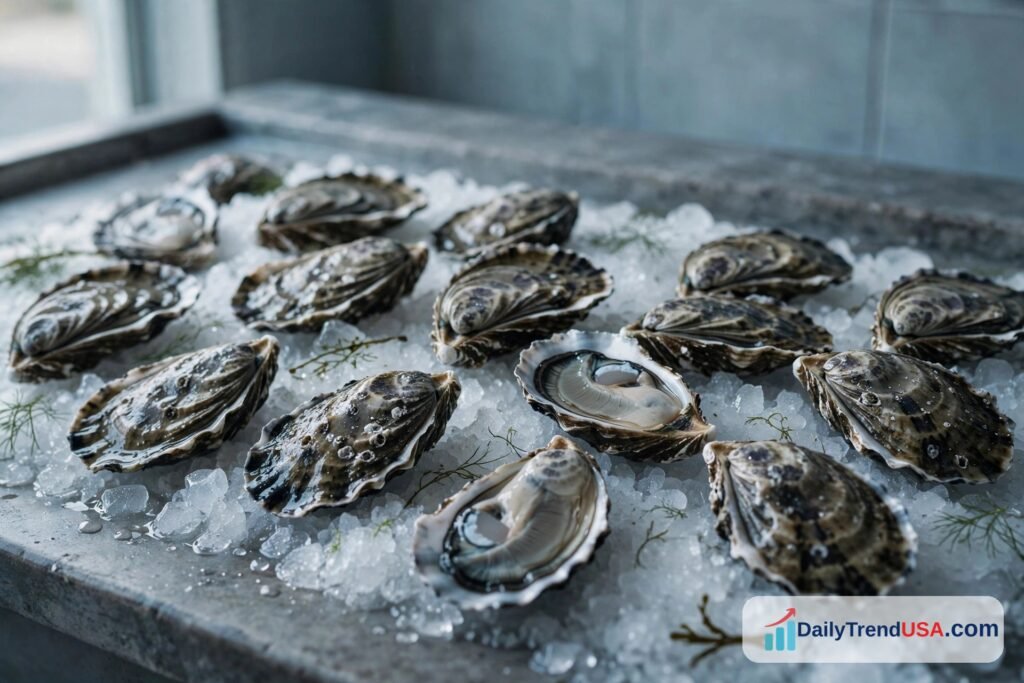
Standfirst: A warning about raw oysters from Stellar Bay Shellfish Ltd. is circulating again in November 2026, but the recall behind it is not new. The Food and Drug Administration expanded its advisory on February 18, 2026, to cover all raw oysters harvested between December 22, 2025 and February 4, 2026 from one British Columbia harvest area. The oysters were sold under four brand names, reached restaurants and retailers in 10 states, and may carry norovirus. Health officials in Washington linked the oysters to 11 illnesses from five meal parties.
Key facts
| Product | Raw oysters harvested by Stellar Bay Shellfish Ltd., British Columbia, Canada |
| Harvest dates | December 22, 2025 to February 4, 2026 |
| Harvest area | BC 17-20 (Nanoose Bay), CLF #1401656 |
| Brands | Kusshi, Chrome Point, Stellar Bay, and Stellar Bay Gold |
| Hazard | Potential norovirus contamination |
| States | California, Colorado, Florida, Hawaii, Illinois, Maryland, Nevada, New York, Pennsylvania, and Washington |
| What to do | Do not eat the oysters. Throw them away or return them through your distributor. |
What we know
The warning covers a full harvest window: on February 18, 2026, the FDA expanded its advisory to include all raw oysters harvested between December 22, 2025 and February 4, 2026 from British Columbia harvest area BC 17-20 (Nanoose Bay), CLF #1401656, by Stellar Bay Shellfish Ltd.
Four brands are affected: the oysters were sold under the Kusshi, Chrome Point, Stellar Bay, and Stellar Bay Gold brand names. All four come from the same harvester and harvest area, so the brand name alone does not settle it.
Illnesses were reported in Washington: the Washington State Department of Health reported that 11 people from five different meal parties had norovirus-like illness symptoms after eating raw oysters from this harvest area, with exposures between January 17 and February 1, 2026. Washington told the FDA on February 3, 2026, and California told the FDA about a recall on February 5, 2026. A recall in Canada covered oysters from the same harvest area harvested January 28 and 29, 2026.
The oysters went to 10 states: the FDA lists California, Colorado, Florida, Hawaii, Illinois, Maryland, Nevada, New York, Pennsylvania, and Washington as the states where the oysters were shipped to distributors. The agency said they may have reached other states.
What we don’t know
The total illness count is not settled: the FDA advisory gives no total number of illnesses linked to these oysters. The figure of 11 people from five meal parties comes from Washington State alone, and no case count is public for California or any other state.
The full distribution list is not public: the FDA said it was awaiting further information on distribution, and it has not published a list of the specific restaurants or retailers that received the oysters. Shoppers have to check the harvest information on the oysters they bought, or ask the seller where the oysters came from.
One date does not match: a Mesa County Public Health notice lists February 6, 2026 as the end of the harvest window, while the FDA advisory lists February 4, 2026. No public notice explains the two-day gap. Anyone with oysters from this harvest area dated February 5 or 6, 2026 should check with the seller or a local health department before eating them.
Why the warning is circulating again
The FDA action dates to February 2026: the expansion at the center of this article was published by the FDA on February 18, 2026. No new FDA action on this recall was found in November 2026. Readers seeing the warning now are seeing an older advisory resurface, not a new recall.
Local health departments republish old alerts: Mesa County Public Health in Colorado first posted its alert about the expanded recall on February 19, 2026, and the notice appeared again on the county site in early November 2026. The FDA has not withdrawn the advisory, so the advice still stands.
Related Daily Trend USA coverage: FDA Warns of Salmonella in Little Wicomico Oysters From Virginia, BetterBallen Frozen Snacks Recalled Over Public Health Alert, and Food Recall? How to Check If Your Kitchen Is Affected.
What was recalled
The recall grew in steps: Washington health officials first flagged oysters harvested on December 30, 2025 and January 20, 2026, and the FDA issued its first advisory on February 13, 2026, covering only four harvest dates. Then California reported a recall of oysters harvested on January 26 and 29, 2026, and more norovirus-like illnesses were linked to oysters harvested on January 13 and 29, 2026.
The expansion closed the gaps: rather than keep adding single dates, the FDA expanded the warning on February 18, 2026 to cover every raw oyster harvested between December 22, 2025 and February 4, 2026 from the same harvest area by the same company. The advisory applies only to raw oysters from this harvester and this harvest area, not to all oysters or all Canadian oysters, and the tag on a bag or box of shellfish shows the harvest area and date that decide whether the oysters fall under the warning.
Norovirus: the hazard and the symptoms
Norovirus is a common cause of stomach illness: it is a very contagious virus that spreads easily through contaminated food and from person to person. Food with norovirus may look, smell, and taste normal, so inspection cannot tell whether raw oysters carry the virus.
The symptoms are familiar and unpleasant: the most common symptoms are diarrhea, vomiting, nausea, and stomach pain. Other symptoms include fever, headache, and body ache. Symptoms usually start 12 to 48 hours after exposure, and most people get better within 1 to 3 days.
Some people face a higher risk: the FDA warns that oysters contaminated with norovirus can cause illness if eaten, and potentially severe illness in people with compromised immune systems. Norovirus can lead to dehydration, especially in young children, older adults, and people with other illnesses. Signs include less urination, dry mouth and throat, and dizziness when standing up. Anyone with symptoms after eating these oysters should contact a health care provider and report the illness to the local health department. This article gives general health information only. It is not medical advice, and it does not diagnose or treat any condition.
How to check oysters you already bought
Start with the shellfish tag: restaurants and retailers must keep the tag that comes with a shipment of shellfish. The tag shows the harvest place and date. At a store, check the label or receipt for the brand, harvest area, and harvest date. The warning applies if the tag says BC 17-20 (Nanoose Bay), CLF #1401656, with a harvest date between December 22, 2025 and February 4, 2026.
Ask the seller if the details are missing: if you ate oysters at a restaurant, ask where they came from and when they were harvested. If you bought them at a store, ask the seafood counter for the same information. If the date is unclear, or if the harvest details cannot be determined at all, do not eat them.
What to do with oysters you already bought
Do not eat them: no one should eat, serve, or sell oysters covered by this warning. The FDA advises restaurants and retailers to throw them in the garbage or contact their distributor to arrange for destruction.
Clean up after handling them: the FDA advises washing hands with warm water and soap after handling the oysters and after cleaning. Sellers of bulk product should clean and sanitize the containers used to hold the oysters. Wash and sanitize cutting boards, countertops, and utensils that touched the oysters.
Watch for symptoms and keep your records: anyone who ate the affected oysters and then developed diarrhea, vomiting, nausea, stomach pain, or fever should contact a health care provider. Reporting the illness to the local health department helps officials track the outbreak. Keep the receipt and tag if you can.
How this differs from the earlier oyster recall
A different company, place, and germ: this Stellar Bay warning is separate from the recall of Little Wicomico Oyster Company oysters from Virginia. The Little Wicomico oysters were whole shellstock, batch VA-1421-SP, harvested from the Little Wicomico River in Virginia between September 18 and October 8, 2026, and linked to Salmonella Telelkebir. The Stellar Bay oysters came from British Columbia months earlier, and the hazard is norovirus, not Salmonella.
A different scale of reported illness: the Little Wicomico outbreak was posted on October 19, 2026, with 27 people infected in 12 states and five hospitalizations, according to the Center for Science in the Public Interest recall list. The Stellar Bay outbreak, as reported by Washington State, involved 11 people from five meal parties in one state. The harvesters, areas, dates, and germs are all different.
Sources
Sources: U.S. Food and Drug Administration, “FDA Advises Restaurants and Retailers Not to Serve or Sell and Consumers Not to Eat Certain Oysters from British Columbia, Canada Harvest Area BC 17-20 CLF #1401656 Potentially Contaminated with Norovirus”, https://www.fda.gov/food/alerts-advisories-safety-information/fda-advises-restaurants-and-retailers-not-serve-or-sell-and-consumers-not-eat-certain-oysters-6, published and updated February 18, 2026; Food Safety News, “FDA expands warning about oysters from Canada”, https://www.foodsafetynews.com/2026/02/fda-expands-warning-about-oysters-from-canada/, published February 18, 2026; Washington State Department of Health, “2026 Norovirus Outbreak Linked to Oysters Harvested in British Columbia”, update February 19, 2026, https://outbreakdatabase-com.s3.amazonaws.com/2026-Norovirus-Outbreak-Linked-to-Oysters-Harvested-in-British-Columbia-WA-DOH-Announcement-Feb-19-2026.pdf; Mesa County Public Health, “Food Safety Alert: Oyster recall expanded due to health concerns”, https://www.mesacounty.us/news/public-health/food-safety-alert-oyster-recall-expanded-due-health-concerns, dated February 19, 2026, republished early November 2026; Center for Science in the Public Interest, “Food recalls to watch right now”, updated November 2026, https://www.cspi.org/recalls. All sources read November 9, 2026.