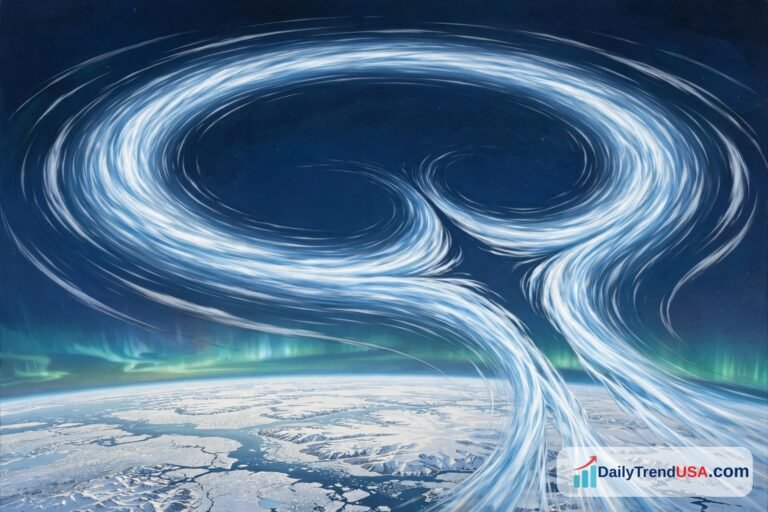


The northern lights may be visible across the northern United States on Friday night, November 6, as a G1 (minor) geomagnetic storm reaches its peak. NOAA’s Space Weather Prediction Center forecasts the strongest activity between 10 p.m. Friday and 1 a.m. Saturday ET, with the lights most likely over northern Michigan, Maine, and the Upper Midwest.
What we know / What we don’t know
What we know
- NOAA’s Space Weather Prediction Center has issued a G1 (minor) geomagnetic storm watch for November 6 through 8.
- The strongest stretch is forecast for 10 p.m. Friday to 1 a.m. Saturday ET, when the planetary K-index, or Kp, is expected to reach 5, the threshold for a G1 storm.
- The storm is driven by a fast stream of solar wind from a large coronal hole, not by a coronal mass ejection.
- At G1 strength, the aurora is most likely visible from the northern tier of the country, including northern Michigan and Maine.
- There is also a chance of G2 (moderate) storm levels over the next three days, which could push the lights as far south as New York and Idaho.
What we don’t know
- The exact timing and strength of the storm can still shift. As of early Friday evening, geomagnetic activity was still quiet, with the highest Kp reading of the past 24 hours at 3, below storm levels.
- Cloud cover will decide whether anyone actually sees the lights. Forecasters warn that clouds, and rain or snow in some areas, could block the view across parts of Michigan.
- Whether the storm reaches G2, and how far south the aurora extends, will only be clear as live readings come in overnight.
Key facts
| Storm level | G1 (minor) geomagnetic storm, the weakest level on NOAA’s G1 to G5 scale |
| Peak Kp forecast | 5, in the 10 p.m. Friday to 1 a.m. Saturday ET window |
| Watch period | November 6 to 8, with further G1 chances on November 8 and 9 |
| Best viewing areas | Northern Michigan, Maine, the Upper Midwest, and northern New England |
| Possible extension | If the storm reaches G2, the aurora could reach New York and Idaho |
| Cause | Fast solar wind from a large coronal hole |
| Source | NOAA Space Weather Prediction Center, 3-day forecast issued November 7, 00:30 UTC |
When to look tonight
The best time to look is late Friday evening. NOAA’s latest three-day forecast, issued at 7:30 p.m. ET on Friday, puts the strongest geomagnetic activity in the 03:00 to 06:00 UTC window on November 7, which is 10 p.m. Friday to 1 a.m. Saturday in the Eastern time zone. That is when the Kp index is expected to reach 5.
The storm is expected to build during the evening, so conditions may improve as the night goes on. NOAA’s general advice for aurora watching is to look around midnight, when the sky is darkest and activity often peaks. The aurora forecast is updated every 30 minutes, so the picture can change quickly.
It is worth remembering that the storm had not yet arrived as of early Friday evening. The highest Kp reading of the past 24 hours was 3, which is below storm levels. The G1 storm is a forecast, not a certainty, and the timing could move by a few hours in either direction.
Where the lights could appear
At G1 strength, the northern lights are expected to be visible from the northern tier of the United States. NOAA’s guidance points to northern Michigan and Maine as the most likely spots, with the Upper Midwest and northern New England also in with a good chance. Alaska, as usual, has the best odds of all.
The lights appear low on the northern horizon at these latitudes, so a clear view to the north matters as much as the storm strength. City lights wash out faint auroras, so the best views come from dark places away from towns. Even a short drive out of a city can make a real difference.
Clouds are the biggest risk to the show. Local National Weather Service offices expect clouds overnight across parts of Michigan, with rain or snow in some areas on Friday night, according to the Detroit Free Press. If the sky is covered where you are, no storm, however strong, will be visible. Check your local forecast before heading out.
If the storm strengthens to G2, the viewing area grows. At G2, the aurora could extend as far south as New York and Idaho, based on NOAA’s standard latitude thresholds. NOAA gives a chance of G2 conditions on November 7 or 8, so the weekend may offer a second chance.
Why this storm is happening
This storm was not caused by a solar flare or a coronal mass ejection, the dramatic eruptions that drive the biggest aurora displays. Instead, it comes from a coronal hole, a dark region in the Sun’s outer atmosphere where the magnetic field opens up and lets solar wind stream out faster than usual.
Forecasters have been tracking this particular coronal hole since at least November 3. It is unusually large and oddly shaped, and the fast stream of charged particles it sends toward Earth is now arriving. When that stream hits Earth’s magnetic field, it stirs up the geomagnetic activity that produces the northern lights.
NOAA posted its G1 storm watch on Thursday evening, November 5, giving skywatchers days of warning. The Sun is currently near solar maximum, the busiest part of its roughly 11-year cycle, which is why aurora chances have been higher than usual this year. In the past seven days, the Sun produced 23 flares of C class or stronger, the strongest an M3.5 flare on November 5, and nine coronal mass ejections, none of them headed toward Earth.
Space weather reaches beyond the aurora: the Artemis II launch recently disturbed part of Earth’s ionosphere, the same upper layer of the atmosphere where auroras form. It has also been a busy week for space news in other ways: NASA’s Swift telescope burned up over Indonesia after its mission ended.
How to see the northern lights
You do not need special equipment to see the aurora, but a few simple steps will help.
Get away from city lights. The aurora is often faint at mid-latitudes, and light pollution can hide it completely. A dark rural spot with a clear view to the north is ideal.
Let your eyes adjust. Give your eyes 15 to 20 minutes in the dark. Phone screens ruin night vision, so check the forecast, then put the phone away.
Look north and low. From the northern United States, the aurora usually appears as a glow or rippling curtains low on the northern horizon. It may look grey or pale green to the naked eye at first. A camera on a long exposure often picks up more color than the eye can see.
Be patient. The aurora brightens and fades in waves. If you see nothing after a few minutes, wait. Activity can surge suddenly and last for 10 to 20 minutes before fading again.
Dress warm. Temperatures across the northern tier will be cold overnight, and you may be standing outside for a while. Bring layers, a hot drink, and a chair if you plan to stay out.
What a G1 storm can — and can’t — do
A G1 storm is the weakest level on NOAA’s five-step geomagnetic storm scale, which runs from G1 (minor) to G5 (extreme). For most people, the only visible effect is the aurora itself.
NOAA lists weak power-grid fluctuations and a minor impact on satellite operations as possible effects of a G1 storm, mainly at latitudes above 60 degrees geomagnetic. In plain terms, that means far northern Canada and Alaska, not the lower 48 states. There is no expected impact on everyday life, phones, or the power grid in the United States.
The same storm can also disturb high-frequency radio signals and GPS accuracy slightly at high latitudes. For most readers, though, the storm is a skywatching event, not a safety concern.
A G1 storm is not expected to knock out power in the United States. But if a storm ever does cut power, generator safety matters, including the carbon monoxide risk.
It is worth keeping the scale in mind. A G1 storm brings the lights to the northern tier. A G4 or G5 storm, the kind seen in May 2024, can push them as far south as Florida and Texas. Tonight’s storm is a modest one, and expectations should match that.
What happens next
The G1 watch runs through November 8, and NOAA’s forecast keeps the chance of storm levels going into November 9. The strongest windows after tonight fall on Sunday afternoon and evening, November 8, when Kp is again forecast to reach 5, and again late on November 8 into November 9. If clouds spoil Friday night, the weekend may offer another opening.
The aurora is never guaranteed. Forecasts give the odds, but the Sun and the weather have the final say. The best plan is simple: check the sky late Friday night, look north from the darkest spot you can reach, and be ready to wait.
Sources
- NOAA Space Weather Prediction Center, 3-day forecast, issued November 7, 2026, 00:30 UTC: https://services.swpc.noaa.gov/text/3-day-forecast.txt
- Tech Times, “Aurora Forecast for Nov 6-8 Had Days of Warning: Coronal Hole, Not CME, Drove Storm”: https://www.techtimes.com/articles/330176/20261106/aurora-forecast-nov-6-8-had-days-warning-coronal-hole-not-cme-drove-storm.htm
- Detroit Free Press, “Strong northern lights forecast. Clouds will make viewing difficult”: https://www.freep.com/story/news/local/michigan/2026/11/06/northern-lights-aurora-borealis-michigan-weather/92639492007/
Published November 6, 2026. Forecast details from NOAA’s Space Weather Prediction Center; viewing conditions depend on local cloud cover.