

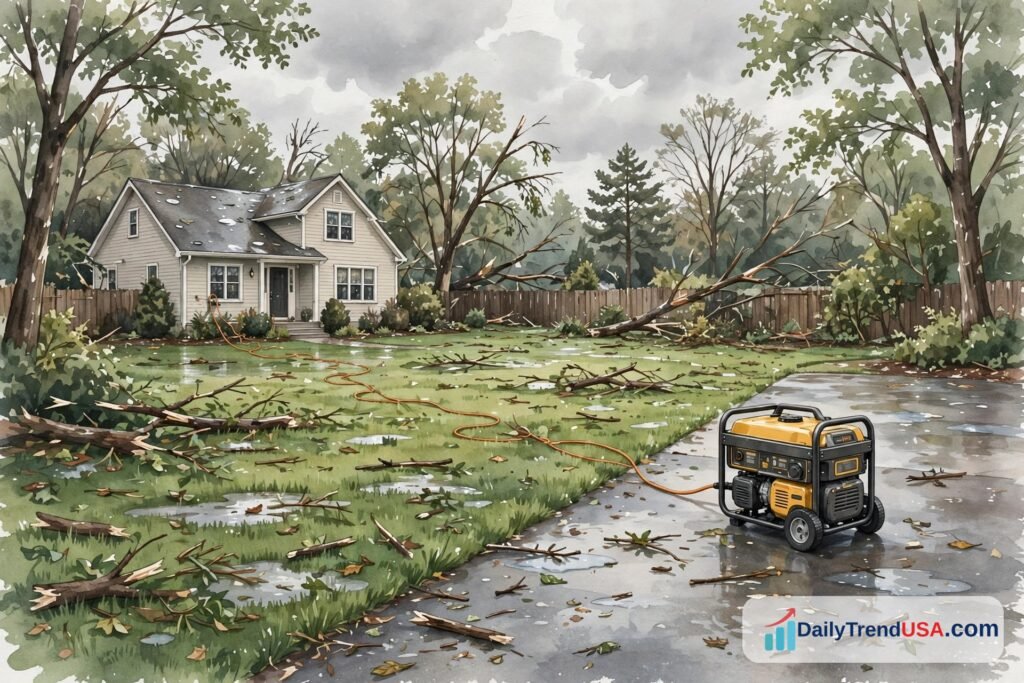
Standfirst: A portable generator can keep the lights on and the food cold when a storm knocks out the power, but it can also fill a home with carbon monoxide, a gas you cannot see or smell. The U.S. Consumer Product Safety Commission estimates that about 100 people die each year in the United States from carbon monoxide poisoning linked to portable generators. The good news is that nearly all of these deaths are preventable. The rules are simple: run the generator outside, at least 20 feet from the house, and make sure your home has working carbon monoxide alarms.
Why generators can be deadly
- Carbon monoxide: Carbon monoxide, often called CO, is a colorless and odorless gas. You cannot see it and you cannot smell it, so you will not know it is building up in your home until it is too late.
- How much one generator makes: One portable generator can produce as much carbon monoxide as hundreds of cars. That is why a generator that seems small can still be dangerous when it is run in the wrong place.
- The toll: The U.S. Consumer Product Safety Commission estimates that about 100 people die each year in the United States from carbon monoxide poisoning linked to portable generators. The Centers for Disease Control and Prevention counts more than 400 deaths a year from unintentional carbon monoxide poisoning not linked to fires, from all sources.
- When the risk rises: The danger is highest after storms, when families run generators to keep warm, keep food cold, and charge phones. Many of these deaths happen at night, while people are asleep and cannot notice the warning signs.
- The lesson: A generator is a useful tool, but it is not a household appliance. It belongs outside, far from the house, and needs the same care as any machine that burns fuel.
The 20-foot rule
- Outdoors only: Run a portable generator outdoors only, at least 20 feet from your home. That distance is the minimum, and more distance is better when you have the space.
- Point the exhaust away: Aim the exhaust away from the house and away from any door, window or vent. Carbon monoxide can drift through an open window or vent and build up inside even when the generator is outside.
- Never run it inside: Never run a generator inside a home, garage, basement, crawlspace, shed or porch, even with the doors or windows open. An open garage door does not make it safe. The gas can still collect in the enclosed space and seep into the living areas of the home.
- Watch the neighbors: Keep the generator away from your neighbors’ homes too. A generator placed close to a shared wall or a nearby window can send carbon monoxide into someone else’s home.
- Measure it: Before the storm, pace out 20 feet from your house and mark the spot where the generator will sit. When the power goes out and it is dark and raining, you will not want to guess.
Carbon monoxide alarms
- Install them on every level: Put battery-powered carbon monoxide alarms on every level of your home and outside each sleeping area. An alarm is your backup warning system for a gas you cannot see or smell.
- Test them monthly: Test your carbon monoxide alarms every month by pressing the test button. A dead alarm gives no warning at all, so a monthly test is a small habit that can save a life.
- Replace them when the maker says so: Replace alarms as the maker directs. Most alarms have a set service life, and an old alarm may not sound when it should. Check the date printed on the back of the unit.
- Check them with the clocks: If you change your clocks for daylight saving time, use that moment to check your alarms too. Our guide on checking smoke alarms when the clocks fall back explains a simple routine that covers both smoke and carbon monoxide alarms at the same time.
- Buy a safer model: If you are buying a new generator, choose a model with a built-in carbon monoxide shut-off feature. Models certified to PGMA G300-2023 and UL 2201 include carbon monoxide safety technology that shuts the generator down before dangerous levels build up.
Never plug a generator into a wall outlet
- What backfeeding is: Never plug a generator directly into a wall outlet. This practice, called backfeeding, sends power from the generator back through your home wiring and out to the power lines outside.
- Why it is dangerous: Backfeeding can energize power lines that utility workers believe are dead, putting repair crews at serious risk. It can also overload your home wiring and start a fire.
- The safe way to power your home: If you want the generator to power your home’s circuits, have a licensed electrician install a transfer switch. A transfer switch safely connects the generator to your home wiring and keeps the generator’s power separate from the utility lines.
- Use the right cords: If you are running appliances directly from the generator, use heavy-duty, outdoor-rated extension cords. Make sure the cords are in good shape, with no cuts or frayed ends, and keep the connections dry and off the ground where possible.
Refuel safely
- Let it cool first: Always let the generator cool down before you refuel it. Pouring gasoline onto a hot engine can cause a fire in seconds.
- Refuel outdoors: Refuel outdoors, away from the home. Never refuel a generator inside a garage or shed, where fuel vapors can collect.
- Store fuel properly: Store fuel in approved containers, away from living areas and away from anything that could spark or catch fire. Keep containers out of reach of children.
- Keep fuel on hand: Before storm season, make sure you have enough fuel and oil stored safely so you are not driving out in a storm to find an open gas station.
Know your load
- Check the wattage: Every generator has a rated wattage, which is the amount of power it can safely provide. Know your generator’s wattage before the outage, and do not overload it. Overloading can damage the generator and the appliances plugged into it.
- Prioritize the essentials: During an outage, power the essentials first: the refrigerator and freezer, a few lights, and any medical devices that need power. Leave the rest off until you are sure the generator can handle it.
- Add one thing at a time: Start the generator first, then plug in appliances one at a time. Adding everything at once can trip it or overload it.
- Read the manual: Every generator model is a little different. Read the manual before the storm so you know how to start it, how to shut it off safely, and what its limits are.
Keep the generator dry
- Run it on a dry surface: Run the generator on a dry surface, and keep it out of standing water. Water and electricity are a dangerous mix, and a generator sitting in a puddle can shock anyone who touches it.
- Shield it from rain: A canopy-style cover that is open on all sides can shield the generator from rain. Never enclose the generator in a box or tent, because that traps exhaust and heat and can push carbon monoxide back toward the house.
- Dry your hands: Make sure your hands are dry before you touch the generator or its controls.
Know the warning signs of carbon monoxide poisoning
- The symptoms: The symptoms of carbon monoxide poisoning include headache, dizziness, weakness, upset stomach, vomiting, chest pain and confusion. These signs can be easy to mistake for the flu or for tiredness after a long storm day.
- Sleep is the danger: People who are asleep can die from carbon monoxide poisoning before feeling any symptoms. That is why working alarms matter so much at night, and why a generator should never be run close to a bedroom window.
- What to do: If you suspect carbon monoxide poisoning, get fresh air immediately and call 911. Move everyone outside into the open air right away, and do not go back inside until emergency responders say it is safe.
- Do not wait it out: If an alarm sounds, treat it as a real warning. Get outside, call for help, and let responders check the home. Never ignore an alarm or assume it is a false alarm.
Before the outage: get ready now
- Test it before storm season: Test the generator before storm season arrives. Start it up, run it for a while, and make sure it works. A generator that will not start in the middle of a storm is no help at all.
- Keep supplies ready: Keep fuel and oil on hand, and know how to start the generator without looking at the manual. Practice once in calm weather.
- Know your outage plan: Have a plan for what to do when the power goes out. Our guide on what to do at home during a power outage walks through the first steps, from keeping the fridge closed to knowing when to leave.
- Protect the home before the storm: A little preparation before the storm hits can prevent bigger problems. See our guide on protecting your home from storm flooding before it hits for steps to take while the weather is still clear.
- Share the rules: Make sure everyone in the household knows the rules: the generator stays outside, at least 20 feet from the house, and nobody runs it inside for any reason. The safest generator is the one the whole family knows how to use.
Sources
- U.S. Consumer Product Safety Commission (CPSC): https://www.cpsc.gov/
- Centers for Disease Control and Prevention (CDC): https://www.cdc.gov/
- Ready.gov: https://www.ready.gov/