

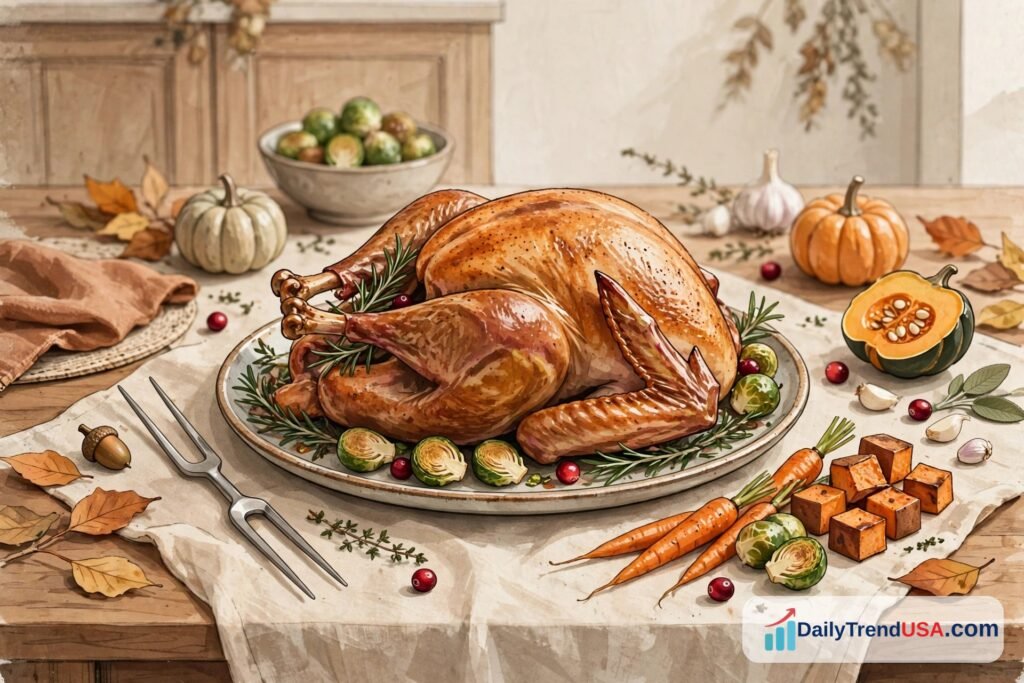
Standfirst: Most Thanksgiving food-safety problems come from three mistakes: thawing too late, undercooking, and leaving leftovers out too long. The fixes are simple: start thawing early, cook to 165 degrees, and refrigerate within 2 hours.
Thawing: start earlier than you think
The fridge method: thawing in the refrigerator is the safest method, but it is also the slowest. Allow about 24 hours for every 4 to 5 pounds of turkey. That means a 16-pound turkey needs about 4 days in the fridge, and a 20-pound turkey needs about 5 days.
The cold-water method: if you are short on time, you can thaw a turkey in cold water, changing the water every 30 minutes. Allow about 30 minutes per pound. A 16-pound turkey takes about 8 hours this way, and the turkey must be cooked immediately after thawing.
What not to do: never thaw a turkey on the kitchen counter, in a garage, or in a warm room. The outside warms up while the inside is still frozen, and that warm outer layer is where bacteria grow fastest. The same warning applies to any large cut of meat, not just turkey.
Cooking: the thermometer is the rule
The target temperature: cook turkey to an internal temperature of 165 degrees Fahrenheit, measured in three places: the thickest part of the breast, the innermost part of the thigh, and the innermost part of the wing. Colour alone is not a reliable test — a turkey can look done and still be undercooked inside.
Stuffing safety: if you stuff the turkey, the stuffing must also reach 165 degrees. Many food-safety experts recommend cooking stuffing separately, because stuffing inside the bird takes longer to reach a safe temperature and can dry out the meat while you wait.
Resting time: let the turkey rest for at least 20 minutes after cooking before carving. Resting lets the juices redistribute, which keeps the meat moist, and it gives the temperature time to settle evenly through the bird.
The 2-hour rule for the table
The rule: perishable food should not sit at room temperature for more than 2 hours, and for only 1 hour if the room is above 90 degrees. Thanksgiving tables often break this rule, because food goes out early and guests graze for hours.
A simple fix: serve food in smaller batches and keep the rest refrigerated, refilling dishes as needed. That way the food on the table is fresh, and the bulk of the meal stays cold until it is served.
What counts as perishable: turkey, gravy, stuffing, mashed potatoes, casseroles, and any dish made with eggs or dairy all count. Cranberry sauce and bread are less risky, but they do not make the rest of the table safe.
Leftovers: fridge, freezer, and reheating
Fridge life: cooked turkey and other Thanksgiving leftovers last 3 to 4 days in the refrigerator, stored in shallow containers that cool quickly. Label containers with the date if you think you will lose track over a busy weekend.
Freezer life: turkey freezes well for 2 to 6 months if wrapped tightly to prevent freezer burn. Freeze in portion-sized containers, so you can thaw only what you need, rather than a single large block that must all be eaten at once.
Reheating: reheat leftovers to 165 degrees, and reheat sauces, soups, and gravy until they boil. Reheat only once, and discard anything that has been reheated and then left out again. When in doubt, the safest choice is to throw it out — a leftover is never worth a stomach bug.
Side dishes deserve the same care
Turkey gets the attention, sides get forgotten: mashed potatoes, gravy, stuffing, and casseroles follow the same rules as turkey, because they are also perishable. Gravy left simmering on the stove for hours is not automatically safe, and a casserole that has sat out all afternoon should be refrigerated or discarded, not saved for tomorrow. The practical habit is the same as for the main dish: serve in smaller batches, keep the bulk refrigerated, and reheat to a boil or to 165 degrees. Side dishes also cool faster in shallow containers, which is why wide, flat containers beat deep bowls for leftovers.
What we know / What to double-check
What is settled: the 165-degree cooking temperature, the 2-hour room-temperature limit, and the 3-to-4-day fridge life for leftovers are standard U.S. food-safety guidance, published by the USDA Food Safety and Inspection Service and FoodSafety.gov.
What varies: thawing time depends on the weight of your bird, and cooking time depends on whether the turkey is stuffed, the oven temperature, and the size of the bird. Always use a food thermometer rather than a time chart alone.
A note on advice: this guide gives general food-safety information only. It is not medical advice, and it does not replace the instructions on your turkey’s packaging or your local health authority’s guidance.
A simple Thanksgiving checklist
A week before: check the turkey’s weight, work out the fridge thawing time, and clear space in the refrigerator. Buy a food thermometer if you do not own one — it is the single most useful tool for Thanksgiving cooking.
The day before: confirm the turkey is thawed, prepare dishes that can be refrigerated, and set out serving dishes so you are not rushing on the day.
On the day: cook to 165 degrees in three places, rest the bird, serve in batches, and refrigerate leftovers within 2 hours. Freeze what you will not eat in 3 to 4 days.
The bottom line: Thanksgiving should be remembered for the meal, not for the aftermath. Thaw early, cook to temperature, and get leftovers into the fridge on time — three habits that protect everyone at the table.
Related Daily Trend USA coverage: Food Recall? How to Check If Your Kitchen Is Affected, More Than 44,000 Cans of Walmart’s Great Value Fruit Cocktail Recalled Over Possible Lead Contamination, and Kayem Foods Recalls 1.58 Million Pounds of Hot Dogs, Bacon and Deli Meats After Cooler Failure.
Sources: guidance consistent with USDA Food Safety and Inspection Service turkey thawing and cooking guidance and FoodSafety.gov leftovers guidance, November 2026.