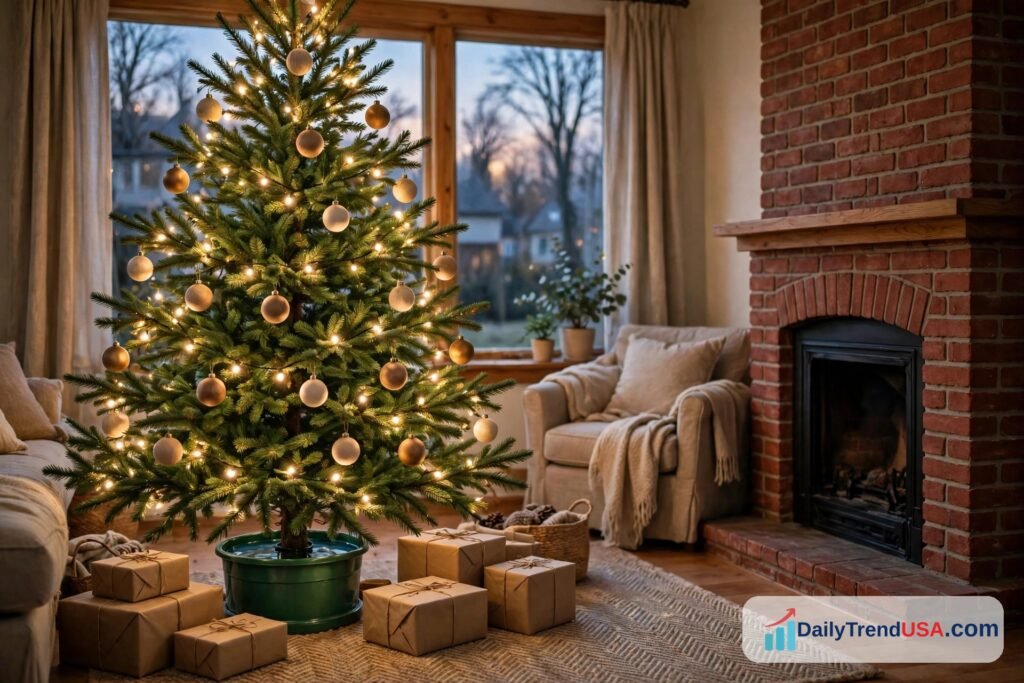
Standfirst: A real Christmas tree brings the holiday into the house, and it also brings a fire risk that grows every day it stands indoors. The National Fire Protection Association reports that United States fire departments answered an average of 143 home fires that started with a Christmas tree each year from 2020 through 2024. The risk is small, but the fires are fast and serious. The good news is that three habits cover most of it: keep the tree watered, keep it away from heat, and turn the lights off at night.
Key facts
| Fact | Detail |
|---|---|
| Christmas tree fires per year | About 143 on average, 2020 to 2024 (NFPA) |
| Leading cause | Electrical problems cause more than 1 in 4 of them |
| Heat too close | A heat source too close to the tree causes about 1 in 4 |
| Worst month | 35 percent of Christmas tree fires happen in January |
| Distance | Keep the tree at least 3 feet from any heat source |
| Water | Add water to the stand every day |
| Lights | Turn them off before bed and before leaving the house |
| Disposal | Get rid of the tree after Christmas or as soon as it dries out |
Why a dry tree is dangerous
A Christmas tree fire is rare, but it is far more dangerous than most house fires. The National Fire Protection Association found that electrical distribution or lighting equipment is involved in about four in ten home Christmas tree fires, and a heat source placed too close to the tree accounts for a large share of the rest. Nearly one in four Christmas tree fires were started by lamps or bulbs, and 12 percent were started by candles, according to data cited by the Philadelphia Fire Department.
The reason is dryness. A freshly cut tree holds water, and water resists fire. As the tree sits indoors, it dries out, and dry needles catch fire far more easily than fresh ones. A fire test by the National Institute of Standards and Technology showed how fast it happens: a dry, unwatered tree became fully engulfed in flame in under 10 seconds of ignition.
That is also why the risk climbs after Christmas. The National Fire Protection Association reports that 35 percent of Christmas tree home fires occur in January, more than a third, because trees kept up past the holidays have had more time to dry out. Watering the tree daily while it is up, and taking it down promptly once the season is over, are the two simplest ways to cut the risk.
Picking the tree
Start at the lot or the farm. Choose a tree with fresh, green needles that do not fall off when touched. Run a branch through your hand: a few loose needles are normal, but a shower of dry needles means the tree is already drying out. A fresh tree is heavier than it looks, because it is full of water.
Before placing the tree in its stand, cut two inches from the base of the trunk. A fresh cut lets the tree absorb water and stay hydrated. Then put the tree in the stand right away and fill the stand with water. Do not be surprised if the tree drinks a lot of water on the first day. A freshly cut tree can absorb a large amount in the first 24 hours.
Place the tree at least three feet away from any heat source, including fireplaces, radiators, candles, heat vents, wood stoves and lights. Also make sure the tree is not blocking an exit. The tree should stand where people can get out of the room without walking past it.
Water it every day
Add water to the tree stand every day, and check the water level daily. A tree can drink a lot, especially in a warm room, and a stand that runs dry lets the tree start drying out within a day. Keep the water level above the cut end of the trunk at all times. If the cut end dries out and seals over, the tree cannot take up water even if the stand is refilled, and it will dry out faster from then on.
If the tree starts dropping needles heavily, or the needles feel dry and brittle, it is drying out. Water it more often, keep it further from heat, and plan to take it down sooner rather than later. A dry tree in the living room is a fire risk that grows by the day.
Lighting the tree safely
Use lights that have the label of a recognized testing laboratory. Check whether your lights are rated for indoor use, outdoor use, or both, and use them only where they are rated. Before you put lights on the tree, check every string for worn or frayed cords, cracked sockets, and loose connections. Replace any string of lights with worn or frayed cords. Do not try to repair a damaged string with tape.
Do not overload an outlet or an extension cord with too many strings. Follow the maker’s instructions for how many strings can be connected end to end. Keep the cords where they will not be pinched by furniture or walked on.
Never use lit candles to decorate the tree. A candle next to dry needles is one of the fastest ways to start a tree fire, and 12 percent of Christmas tree fires were started by candles. Use battery candles instead if you want the look of a flame.
Always turn off Christmas tree lights before leaving home or going to bed. Lights left on overnight or while the house is empty are the most common way an electrical fault turns into a fire with nobody there to catch it.
What about artificial trees
An artificial tree does not dry out, but it is not risk-free. Choose one labeled fire resistant, and use the same lighting rules: tested lights, no damaged cords, and lights off at night and when you leave. Store the tree away from heat sources when it is not in use, and do not store a dry real tree in the home or garage after the holidays.
Metal trees need extra care. Never use electric lights on a metal tree. The metal can conduct electricity if a light string is damaged, and the combination can shock or start a fire.
After Christmas: take it down
Get rid of the tree after Christmas or when it is dry. Dried out trees are a fire danger and should not be left in the home or garage, or placed outside against the home. Check with your local community to find a Christmas tree recycling program. Many towns pick trees up at the curb on a set day, and some run drop-off sites where trees are chipped into mulch.
Bring outdoor electrical lights inside after the holidays to prevent hazards and to make them last longer. Coil them loosely, check them for damage as you take them down, and store them where they will stay dry.
The same rule applies to the tree stand and decorations. Put them away clean and dry, and check the light strings once more before storing them, so next year’s setup starts with lights that are safe to use.
The routine, in short
Pick a fresh tree, cut two inches off the trunk, and stand it at least three feet from any heat source without blocking an exit. Water it every day. Use tested lights, check the cords, and never decorate with lit candles. Turn the lights off before bed and before leaving the house. Take the tree down after Christmas, or sooner if it dries out. That routine takes a few minutes a day, and it is what keeps a real tree safe in the living room all season.
Related reading: For more winter safety, see our guide on fireplace and chimney safety before the first fire, our guide on what to pack in a winter storm emergency kit, and our guide on how to prepare your home for freezing weather.
Sources
National Fire Protection Association, Christmas tree safety tip sheet and Christmas tree fires report (2020-2024 data); National Institute of Standards and Technology, Christmas tree fire test (2008); Philadelphia Fire Department, Christmas tree care guidance; Illinois Office of the State Fire Marshal, Christmas tree safety. This article gives general home safety information, not professional inspection advice.