Standfirst: Holiday lights turn an ordinary house into the best-looking home on the street, and they also add one of the season’s most common fire risks. The National Fire Protection Association reports that holiday decorations other than Christmas trees cause about 790 home fires a year in the United States, with about $13 million in property damage. Most trace back to three mistakes: the wrong lights in the wrong place, too many strings on one outlet, or a damaged cord nobody checked.
Key facts
| Fact | Detail |
|---|---|
| Decoration fires per year | About 790 from holiday decorations other than trees (NFPA) |
| Injuries | About 26 civilian injuries and 1 death a year on average |
| Property damage | About $13 million a year |
| Strand limit | No more than 3 mini-light strands linked, or 50 screw-in bulbs |
| Decorating injuries | About 14,800 treated in emergency rooms in the 2022 holiday season (CPSC); about 40 percent were falls |
| Warm wires | If a wire feels warm, unplug the set |
| Outdoor lights | Must be rated for outdoor use |
| Time limit | Temporary holiday lighting is limited to 90 days (National Electrical Code) |
Why lights start fires
A string of Christmas lights is a simple electrical device, and it fails in simple ways. The insulation on an old cord cracks after years in a hot attic or a cold garage. A socket loosens. A bulb breaks. Water gets into a connection that was never built to be outside. Any of those faults can make a wire hot enough to catch nearby material on fire.
Overloading is the other common cause. Every outlet and every cord has a limit, and holiday displays push against it. The more strings joined together, the more current runs through the first cord and plug in the chain. That is why the plug and the first few feet of cord are the parts most likely to overheat.
Check every string before you hang it
Start on the ground, not on the ladder. Unroll each string and look at it closely before it goes up. The National Park Service advises throwing out any strand with cracked lights, excessive kinking, frayed cords, or loose sockets.
Look at the label on the plug or the strand. It should show the mark of a recognized testing laboratory, such as UL, and it should say whether the lights are rated for indoor use, outdoor use, or both. If the label is missing or unreadable, replace the strand.
Plug each string in and let it run for a few minutes while you watch it. Every bulb should light. The wires should not feel warm to the touch. If a wire or plug feels warm, unplug the set and find out why before you switch it on again. Do not try to repair a damaged string with tape. Replace it.
Indoor lights stay inside, outdoor lights go outside
Indoor light strands are built for a dry living room. They are not built for rain, snow, or freezing temperatures. The National Park Service states this plainly: indoor strands are fine for a tree but are not designed for outdoor conditions. An indoor strand hung along a roofline will get wet, and wet wiring can short circuit.
Outdoor strands are built differently. They carry a UL or FM listing for cold and wet conditions, with thicker insulation and sealed connections. Check the tag for the outdoor label before you hang anything outside.
The same rule applies to decorations near the lights. Use nonflammable decorations and keep them away from lights and heat vents. Never use electric lights on a metal tree. A damaged light string on a metal tree can shock anyone who touches it.
The three-strand rule and the outlet
The number to remember is three. The Consumer Product Safety Commission says never to string together more than three sets of incandescent lights, and never to overload electrical outlets. The National Park Service gives the same limit in plain terms: no more than three mini-light strands, or 50 screw-in bulbs, should be linked together.
LED lights draw less power than the old incandescent bulbs, so a set of LEDs may allow more strands on one run. The maker of the lights sets that number, and it is printed on the box or on the strand’s tag. Read it and follow it. Do not assume the limit no longer applies just because the lights are LEDs.
Count the load on each outlet, not just each strand. If the breaker trips, the load is too high. Split the display across more outlets, or use fewer strings.
Extension cords and outdoor outlets
An extension cord is part of the display, and it needs the same care as the lights. Use only cords rated for outdoor use outside. Look for the words “for outdoor use” and a UL listing on the cord’s label. Indoor cords have thinner insulation and no protection against moisture. They crack in the cold and let water in.
Keep cords out from under rugs and carpets, away from doorways and paths where people walk, and clear of anywhere furniture can pinch them. Do not chain extension cords together. Each connection is a point where water and heat can build up. Buy a cord long enough for the run.
Plug outdoor lights into an outlet with ground-fault protection, known as a GFCI outlet. A GFCI cuts power in a fraction of a second if it detects a fault, which is exactly the protection an outdoor display needs. Press the TEST button first. If it does not trip the outlet, do not use it until an electrician has looked at it. Keep plugs and connections off the ground and out of puddles and snow.
Ladder safety while hanging lights
Falls are the biggest injury risk in holiday decorating. The Consumer Product Safety Commission counted about 14,800 holiday decorating injuries treated in emergency rooms during the 2022 holiday season, and about 40 percent of them were falls.
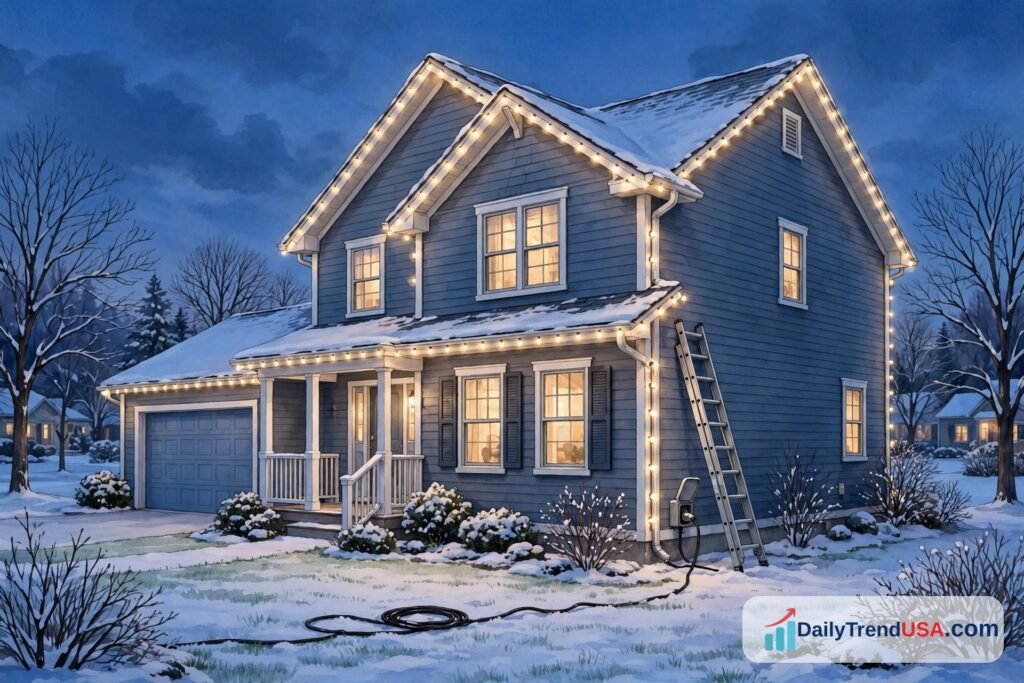
Choose the right ladder for the job, and check it before you climb. Look for cracked rails, loose rungs, and bent feet. Set the ladder on flat, dry ground, never on ice, wet leaves, or a slope. For an extension ladder, use the one-in-four rule: the base should sit one foot out from the wall for every four feet of ladder height. Ask someone to hold the base while you climb.
The National Institute for Occupational Safety and Health lists the basics: keep three points of contact with the ladder at all times, either two hands and a foot or two feet and a hand. Always face the ladder when climbing up or down. Do not overreach. Keep your belt buckle between the rails, and move the ladder instead of leaning out. Do not stand on the top step of a stepladder or above the third rung from the top of an extension ladder. Carry tools in a belt, not in your hands. If the weather turns wet, windy, or icy, come down and wait for a dry day.
Timers and turning the lights off
Lights should not run all night. Turn them off before bed and before leaving the house. A timer makes this easy: set it so the display runs in the evening and switches off before bedtime. That one habit removes the most dangerous hours, when a fault would burn unnoticed while the house sleeps.
Check the display each evening for a dark strand, a scorched plug, or a cord lying in a puddle. A quick look each night catches problems while they are still small.
Keep candles out of the display entirely. A candle near a curtain, a wreath, or dry greenery is a fire waiting for a gust of air. Battery candles give the same look without the flame.
Taking them down and storing them
Holiday lights are temporary, and the National Electrical Code treats them that way. Temporary holiday lighting installations are limited to 90 days. Take the display down after the holidays instead of leaving it up through the winter.
Take the lights down on a dry day. Check each string for damage as you coil it, and throw out any strand with cracked bulbs, frayed cords, or loose sockets. Coil the strings loosely so the wires are not kinked, and store them in a dry place where they will stay dry until next year.
Related reading: For more winter safety, see our guide on Christmas tree safety and keeping the fire risk low, our guide on fireplace and chimney safety before the first fire, and our guide on how to prepare your home for freezing weather.
Sources
U.S. Consumer Product Safety Commission, Holiday Safety (cpsc.gov); U.S. National Park Service, Fire Prevention 52: Deck the Halls Safely (nps.gov), citing National Fire Protection Association figures; National Institute for Occupational Safety and Health, Falls from Ladders Can Be Prevented (CDC stacks); National Electrical Code, temporary holiday lighting limit. This article gives general home safety information, not professional electrical advice.