

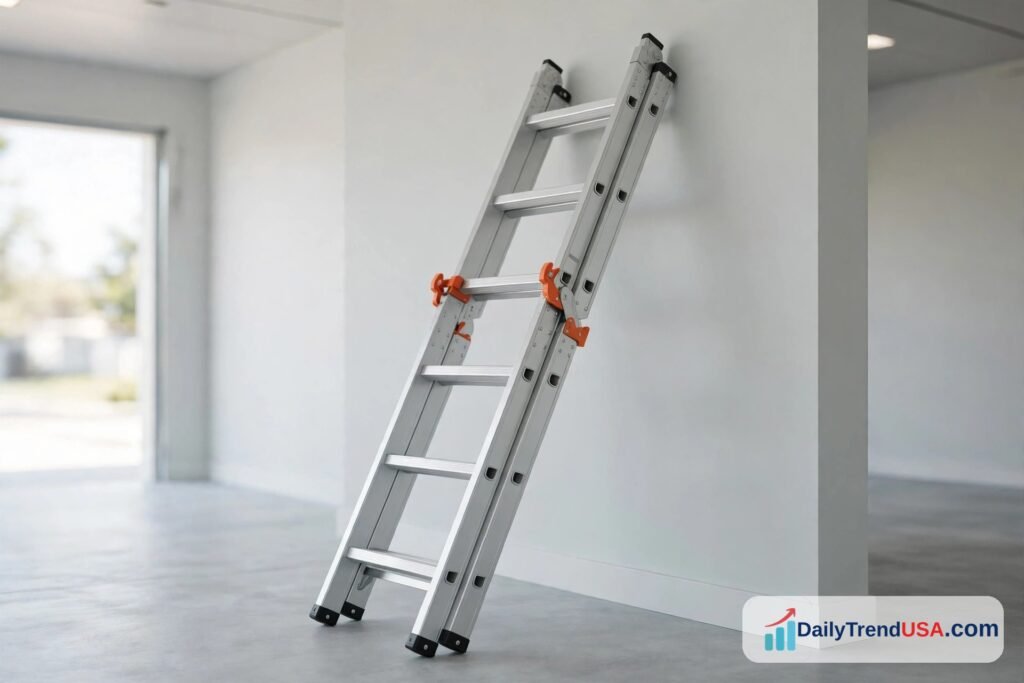
The U.S. Consumer Product Safety Commission announced on November 5, 2026 that Little Giant is recalling 3.66 million ladders with Rapid Locks after reports that the ladders can retract without warning. The agency counts 25 reports of ladders retracting, including 19 injuries — among them head injuries such as traumatic brain injury and skull fracture.
What we know / What we don’t know
What we know:
- The U.S. Consumer Product Safety Commission (CPSC) announced the recall on November 5, 2026. It covers Little Giant ladders fitted with Rapid Locks — the twist-to-adjust locks that hold the ladder’s sliding sections in place.
- About 3,662,000 ladders are included in the recall, according to the CPSC.
- The hazard is that the ladders can retract unexpectedly while someone is using them, creating a risk of serious injury from a fall.
- Little Giant has received 25 reports of the ladders retracting. 19 of those reports involved injuries.
- Three of the injury reports involved head injuries, including traumatic brain injury, skull fracture, concussion, vision loss, hearing loss, and cognitive impairment, according to the CPSC.
- The other 16 injury reports involved injuries such as joint or bone fractures, lacerations, and bruising.
- Little Giant has also received 39 reports of Rapid Locks not working properly.
- Cox Media Group television stations, including WHIO in Dayton, carried a recall alert for the 3.6 million ladders on November 5, confirming the announcement the same day.
- This is not the first time Little Giant’s locking systems have drawn a federal recall. In March 2017, the CPSC announced a recall of about 37,000 Little Giant multipurpose ladders after reports that locking pins and rung fasteners could fail.
What we don’t know:
- The CPSC release summary does not list the specific models, part numbers, or date codes covered by this recall. Those details are in the full CPSC recall notice, and owners should check that notice to see if their ladder is included.
- The release summary does not state the remedy the company is offering, the dates the recalled ladders were sold, or the retailers that carried them. Owners should check the official CPSC notice for that information before deciding what to do next.
- The CPSC has not said how many of the 3.66 million ladders are still in use in American homes, garages, and workplaces, or how many have already been returned or repaired.
- No deaths have been reported in connection with this recall, according to the CPSC figures released so far.
Key facts
- Product: Little Giant ladders with Rapid Locks
- Units recalled: 3,662,000
- Recall announced: November 5, 2026, by the U.S. Consumer Product Safety Commission
- Hazard: Ladders can retract unexpectedly, posing a risk of serious injury from a fall
- Reports of ladders retracting: 25
- Injuries reported: 19 — including 3 head-injury reports (traumatic brain injury, skull fracture, concussion, vision loss, hearing loss, cognitive impairment) and 16 other injury reports (joint or bone fractures, lacerations, bruising)
- Reports of Rapid Locks not working properly: 39
- Deaths reported: None, according to the CPSC figures released so far
- Earlier related recall: March 2017, about 37,000 Little Giant multipurpose ladders (locking pin failures)
What went wrong with the Rapid Locks
Little Giant’s multi-position ladders are built to change shape. The same ladder can work as a step ladder, an extension ladder, a stairway ladder, or a scaffold base, and the Rapid Lock system is what makes that possible. The user twists the lock, slides the rails to the length needed, and twists again to hold the sections in place.
That locking step is the whole safety story. A ladder only holds a person’s weight safely when its locks are fully engaged. If a lock slips or fails to catch, a section can slide back down while someone is standing on it. The ladder shortens without warning, the climber loses balance, and the fall that follows can be from several feet up — onto concrete, a driveway, or a garage floor.
The CPSC’s numbers show this is not a one-off failure. Twenty-five reports of ladders retracting, plus 39 more reports of Rapid Locks simply not working properly, point to a pattern rather than a single bad unit. And the injuries reported so far are serious: three head-injury reports include traumatic brain injury and skull fracture, and the other 16 injury reports include broken bones.
The recall is also striking for its size. At 3.66 million units, it is one of the largest ladder recalls in recent years, and it covers a product that many American households own. Little Giant ladders are widely sold through major home-improvement and online retailers. That reach is exactly why the CPSC moved: a defect that affects a small share of units can still hurt a large number of people when the product is this common.
How to check your ladder
If you own a Little Giant ladder, start with the locks. Look for the Rapid Lock mechanisms on the rails — the twist locks that hold the sliding sections. Then check the official CPSC recall notice, which lists the models, part numbers, and date codes that are included. The notice is the only reliable way to confirm whether your ladder is part of this recall, because the same brand sells many similar-looking models.
Do not use a ladder you believe is affected until you know what the recall says to do. A lock that feels loose, slips, or fails to catch firmly is a warning sign on any ladder, recalled or not. If your ladder’s locks do not hold, stop using it and follow the instructions in the CPSC notice, which gives the company’s contact details and the remedy for owners of affected ladders.
Little Giant’s earlier ladder recalls
The company has been here before. In March 2017, the CPSC announced a recall of about 37,000 Little Giant Velocity, LT, and Liberty multipurpose ladders after reports that the locking pins and rung fasteners could fail, creating a fall hazard. That recall was far smaller than today’s, but the problem it described — a locking part that fails to hold — is similar in kind.
Since then, the company’s locking systems have also been the subject of lawsuits. In October 2025, a Connecticut man filed a lawsuit alleging he fell about 10 feet onto his driveway in June 2024 when his Little Giant Leveler ladder collapsed. In a separate case filed in May 2026, another Connecticut man alleged a Little Giant articulating ladder collapsed and left him with hip and elbow fractures. These are allegations in court filings, not findings by the CPSC, and they do not by themselves prove a defect. But they show that questions about Little Giant’s locks have been raised more than once before today’s recall.
Why this recall matters now
The timing matters for two reasons. First, the recall landed in the same CPSC announcement batch as several other product recalls, including air fryer ovens, speaker batteries, and children’s playsets. Big recalls have been coming steadily: last week, Bodum recalled 5.9 million French presses over burn risk. Second, late autumn is a season when ladders come out of storage: gutters need clearing, holiday lights go up, and roofs need attention before winter. A ladder that has sat unused for months is more likely to be pulled out now, and a lock problem is more likely to show up at the worst moment — when someone is already several feet off the ground.
The scale of the recall also matters for how it will be handled. With 3.66 million units involved, the remedy program will need to reach a very large number of owners, many of whom bought their ladders years ago and no longer have a receipt. That is a common problem with big recalls, and it is one reason the CPSC publishes the full model list: it lets owners identify an affected ladder from the product itself, without paperwork.
Ladder safety basics
Whether or not your ladder is part of this recall, a few simple habits reduce the risk of a fall. Always check the locks before climbing — every lock should click or twist firmly into place, and the ladder should not shift or slide when you put weight on the first rung. Set the ladder on flat, dry ground, keep three points of contact while climbing, face the ladder, and do not carry loads that throw you off balance. Never stand on the top rung or the top cap of a step ladder, where there is nothing left to hold on to.
If a lock feels loose, sticky, or different from how it used to feel, treat that as a reason to stop. Locks wear over time, and a ladder that worked fine last year may not work fine this year. A short check before climbing costs a minute; a fall from a ladder can cost far more.
What happens next
The CPSC notice is the document to watch. It carries the full list of affected models and date codes, the remedy, and the company’s contact information. Owners of affected ladders should follow its instructions, and anyone who was hurt by one of these ladders can report the incident to the CPSC through its SaferProducts.gov portal.
We will update this article if the CPSC or Little Giant releases more detail — including the model list, the sales period, and the remedy — or if the number of reported injuries changes.
Sources
- U.S. Consumer Product Safety Commission, recall notice: Little Giant Recalls Ladders with Rapid Locks Due to Risk of Serious Injury from Fall Hazard
- U.S. Consumer Product Safety Commission release via PR Newswire, November 5, 2026 — CPSC Posts New Product Recalls and Product Safety Warnings to its Web Site
- WHIO (Cox Media Group), “Recall alert: 3.6M Little Giant ladders recalled,” November 5, 2026
- CPSC, March 2017 recall of Little Giant multipurpose ladders (about 37,000 units), via CPSC search records