

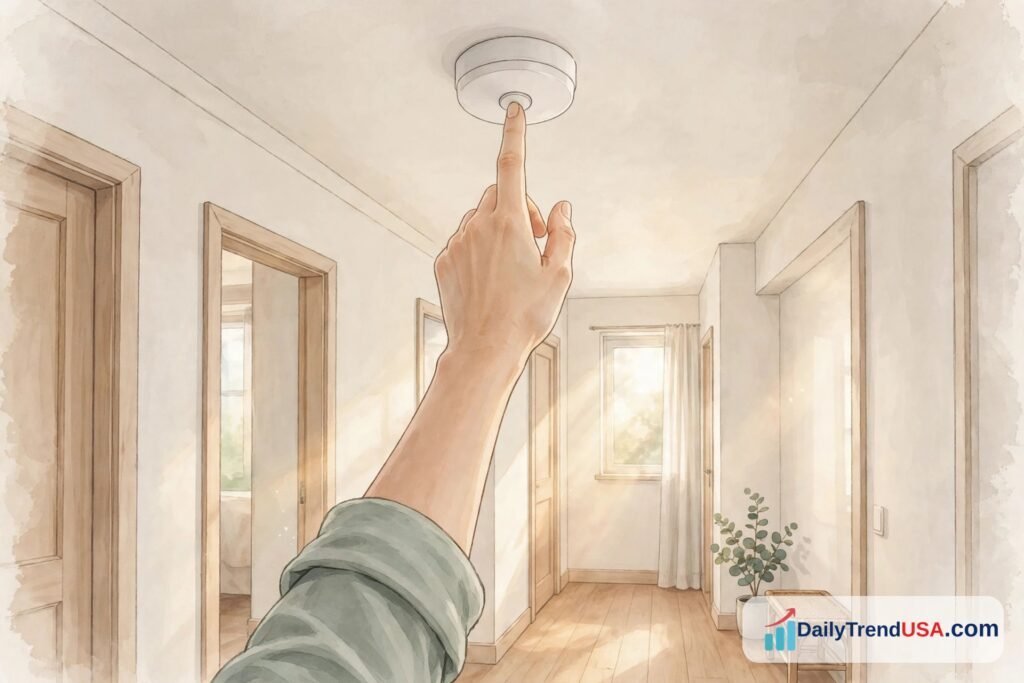
When the clocks fall back, use the extra hour for a job that takes less than ten minutes and can save lives: check every smoke alarm in your home. Fire services have used the clock change as a reminder for years because it happens twice a year, it is easy to remember, and it catches alarms that have quietly stopped working. With daylight saving time ending on November 1, 2026, this weekend is the natural moment to do it.
Why the clock change is the reminder
The habit: Test alarms when the clocks change, in spring and in fall. That gives you two fixed checkpoints a year, so a dead battery or a failed alarm is unlikely to go unnoticed for long.
Why it matters: A smoke alarm can only warn you if it works. Batteries run down, alarms age, and dust builds up inside them. None of that is visible from the hallway, which is exactly why a quick test matters more than a glance at the ceiling.
The timing this year: Clocks fall back at 2 a.m. on Sunday, November 1, 2026, so the hour repeats and the evening gets darker earlier. That darker, colder stretch of the year is also when heating equipment, candles, and cooking get more use — another reason to make sure the alarms are ready before winter sets in.
Where alarms should be
Start with a walk through the house and count what you have. As a general guide, fire-safety guidance calls for alarms in the following places:
- Inside every bedroom. A closed bedroom door slows smoke, so the alarm needs to be in the room with the sleeper.
- Outside each sleeping area. One alarm in the hallway serving the bedrooms covers the escape route.
- On every level of the home. Include the basement, and do not skip a level because nobody sleeps there.
- In the living areas. A main living room alarm gives an earlier warning for fires that start away from the bedrooms.
If any of those spots has no alarm, that is the first gap to fix. Alarms are inexpensive, they are sold in most hardware and general stores, and fitting one is usually a matter of screws or an adhesive mount and a few minutes.
How to test an alarm in under a minute
Testing is deliberately simple, and you should test every alarm, not just one:
- Press and hold the test button until the alarm sounds. A loud, clear alarm means the sounder and the power supply are working.
- Listen from the next room. If you cannot hear the alarm clearly from a bedroom with the door closed, consider an interconnected alarm or an extra alarm closer to the sleeper.
- Check the date on the back. Most smoke alarms should be replaced every 10 years. If the manufacture date is more than 10 years ago, replace the alarm even if the test button still works.
- Note any alarm that does not sound. Replace the battery first if it takes one, test again, and if it still does not sound, replace the whole alarm.
Never test an alarm with real smoke or a flame. The test button is designed for the job, and open flame near a ceiling alarm is a fire risk in itself.
Batteries, sealed alarms, and what to replace
Battery alarms: If your alarm takes replaceable batteries, change them when the alarm chirps and at least once a year. The clock change is a good moment to swap them even if they have not chirped yet.
Sealed-battery alarms: Many modern alarms have a sealed lithium battery designed to last the life of the alarm, about 10 years. These do not need battery changes. When they chirp at the end of their life, replace the whole alarm, not the battery.
Hardwired alarms: Some homes have alarms wired into the mains power, usually with a battery backup. Test them the same way, and replace the backup battery when it chirps. If a hardwired alarm fails its test, have it checked rather than simply removing it.
Chirping at night: A single chirp every minute or so usually means a low battery, not a fire. Replace the battery or the alarm the next morning at the latest, and never remove an alarm and leave the ceiling empty overnight.
Cleaning and common mistakes
Dust and insects can make an alarm less sensitive or cause false alarms. Once a year, vacuum gently around the alarm with a soft brush attachment, and wipe the outside with a dry cloth. Do not paint over an alarm, do not cover it, and do not spray cleaning products into it.
Other mistakes worth avoiding:
- Removing the battery to stop cooking false alarms. Move the alarm a little farther from the kitchen instead, or fit an alarm with a hush button. A removed alarm protects nobody.
- Testing only the nearest alarm. Every alarm needs its own test, because each one has its own battery and sensor.
- Assuming a new home is covered. Check the alarms in a home you have just moved into, even if the previous owner left them in place. You do not know their age or condition.
- Forgetting the basement and garage. Fires do not start only where people sleep. Every level needs coverage.
What to do if an alarm goes off
A sounding alarm means get out, stay out, and call 911 from outside. Do not go back inside to collect belongings, and do not investigate a fire yourself. If everyone in the household knows the escape route and a meeting point outside, a real alarm is far less frightening — and far safer.
Use the clock-change check as a chance to run through the plan with the household too. Make sure children know what the alarm sounds like, which way to go from each bedroom, and where to meet outside. A two-minute conversation now is worth far more than a confused scramble later.
A 10-minute checklist for this weekend
Work through this list room by room, and you will be done before the kettle boils:
- Count the alarms and check that every bedroom, hallway, and level is covered.
- Press the test button on each alarm and listen for a loud, clear sound.
- Check the date on each alarm and replace any that are more than 10 years old.
- Change batteries in any alarm that takes them, if they have not been changed in the last year.
- Vacuum around each alarm gently to clear dust.
- Talk through the escape plan and the outside meeting point with everyone at home.
That is the whole job. Ten minutes, twice a year, and the alarms that are supposed to wake your family in an emergency are far more likely to do it.
Related DailyTrend USA guides: Daylight saving time ends Nov 1: clocks fall back, Power outage at home: what to do and what not to do, and How to prepare your home for freezing weather.


One Comment