
Standfirst: Tesla will wind down production of the Cybertruck at its Texas factory around the middle of 2027 so the plant can build more Cybercabs, CEO Elon Musk said on Friday. The move ends the road for one of the most talked-about vehicles of the decade — but owners will still get parts and service, the truck’s lead engineer said.
What we know / What we don’t know
What we know:
- Elon Musk said on X on Friday, November 6, 2026, that Tesla “will be winding down production of the Cybertruck at Gigafactory Texas around the middle of next year to make room for increased Cybercab production.”
- About 80 minutes before that post, Tesla raised U.S. Cybertruck prices by up to 9% and paused new orders for the entry-level Dual-Motor AWD trim.
- Cybertruck lead engineer Wes Morrill said Tesla will keep supporting trucks already on the road: “Tesla will maintain spare parts and service will continue support.”
- U.S. Cybertruck sales fell to 11,586 in the first nine months of 2026, down 28% from a year earlier, according to Cox Automotive’s Kelley Blue Book estimates.
- Tesla cancelled Cybertruck reservations in Australia and New Zealand on October 23, 2026, with full refunds.
What we don’t know:
- Whether “winding down” means production stops completely or continues at a low rate.
- Whether Cybertruck assembly will move to another factory — Gigafactory Texas is the only plant that builds it today.
- The exact date production will end, and what happens to current orders and waitlists.
Key facts
| Announcement | November 6, 2026, in a post on X by Elon Musk |
| Factory | Gigafactory Texas, Austin — the only Cybertruck plant |
| Timing | “Around the middle of next year” — mid-2027 |
| Reason given | Freeing capacity for increased Cybercab production |
| U.S. sales Jan–Sep 2026 | 11,586, down 28% year over year (Cox Automotive / Kelley Blue Book) |
| Q3 2026 U.S. sales | 4,323, down 19.7% from a year earlier |
| Price move same day | U.S. prices raised by up to 9%; entry Dual-Motor AWD orders paused |
| Cybertruck Premium AWD | Now $92,490, up from $84,990 |
| Owner support | Spare parts and service will continue, per lead engineer Wes Morrill |
What Musk actually said
The announcement came in a single short post on X. Musk wrote: “Tesla will be winding down production of the Cybertruck at Gigafactory Texas around the middle of next year to make room for increased Cybercab production.”
Reuters reported the post on Friday, and the same wording was carried by the Hindu BusinessLine, TradingView and several EV news outlets. Tesla did not add a separate company statement, and Musk did not say whether the truck would be built anywhere else once the wind-down is done.
The timing was striking. About 80 minutes before Musk’s post, Tesla raised U.S. Cybertruck prices by up to 9% and paused new orders for the entry-level Dual-Motor AWD version, according to EVWire, which spotted the changes in Tesla’s U.S. configurator. The Premium AWD version now lists at $92,490, up from $84,990.
Why Tesla is making room for the Cybercab
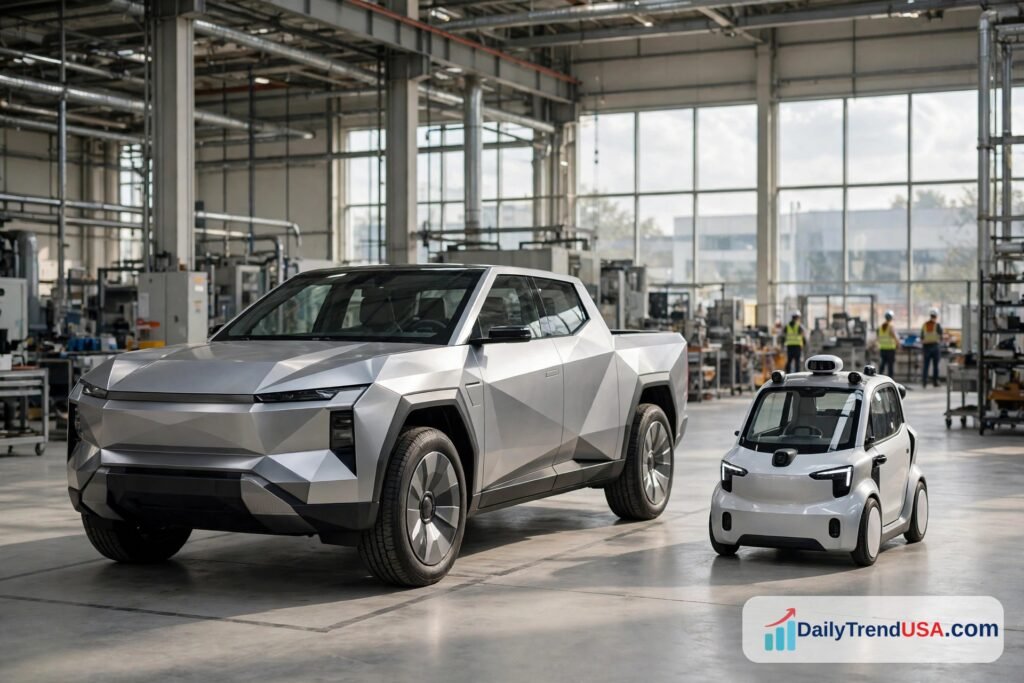
The Cybercab is Tesla’s purpose-built robotaxi — a small, driverless car with no steering wheel — and it is the centerpiece of the company’s bet on self-driving cars. Tesla’s second-quarter 2026 update already reported that Cybercab production had begun at Gigafactory Texas, the same plant that builds the Cybertruck.
Morrill, the Cybertruck’s lead engineer, described the shift as a “handoff” about half an hour after Musk’s post, saying the pickup served as a technology platform that “lives on” in the Cybercab. When owners asked whether trucks already on the road would still be supported, he replied: “Yes, of course! Tesla will maintain spare parts and service will continue support.”
The factory swap makes sense on paper. Gigafactory Texas is the only plant equipped to build the Cybertruck’s specialized stainless-steel body, so freeing that floor space is the fastest way to scale up Cybercab output. What Musk did not say is whether any Cybertruck assembly moves elsewhere, how many Cybercabs the freed lines are meant to add, or what a final Cybertruck run — if there is one — would look like.
The Cybercab, in brief
The Cybercab is the vehicle taking the Cybertruck’s place on the factory floor. It is a compact two-seater built from the ground up to drive itself, with no steering wheel and no pedals. Tesla first showed it in October 2024 and has said it will be the backbone of a robotaxi network, where riders summon a car with an app and no driver is needed at all.
That vision is why the factory switch matters so much to Tesla. A Cybertruck is a niche product: an expensive, polarizing pickup that appeals to a small slice of buyers. A robotaxi, if it works at scale, could earn money around the clock in every major city. Tesla has already begun building Cybercabs at Gigafactory Texas, and the company says production of the vehicle is underway. The Cybertruck wind-down simply hands the factory’s full attention to that bet — and to the Terafab semiconductor and data-center complex Tesla is also building in Texas to support its AI work.
Whether the bet pays off is still an open question. Robotaxis face tough safety rules, city-by-city permits and public trust hurdles, and Tesla’s self-driving software is still under close watch by regulators. But the factory decision shows Tesla is willing to end a headline product to give the robotaxi its best shot.
A truck that never found its footing
The Cybertruck arrived in late 2023 after years of hype, with Musk pitching it as a futuristic rival to pickup trucks from Ford and other legacy makers. Its sharp, stainless-steel body made it instantly recognizable — and instantly divisive.
But sales never matched the early excitement. Cox Automotive’s Kelley Blue Book estimates put U.S. Cybertruck sales at 11,586 in the first three quarters of 2026, down 28% from the same period a year earlier. Third-quarter sales were 4,323, down 19.7%. The truck has also been hit by repeated recalls and quality complaints since its launch, and Tesla has revised prices several times.
The writing was partly on the wall two weeks ago. On October 23, Tesla told Cybertruck reservation holders in Australia and New Zealand that plans to produce the truck for those markets had been discontinued, cancelling reservations with a full refund of payments made.
The announcement also landed in a rough week for Tesla’s stock. Tesla shares fell 11% on Thursday, November 5, as investors weighed the midterm election results and the prospect of tighter scrutiny of Musk’s companies, according to TradingView. Musk’s post on Friday did not mention the stock move.
What this means if you own a Cybertruck — or wanted one
If you already own one: nothing changes right away. Production continues into the middle of next year, and Morrill has said parts and service support will continue. The bigger question for owners is resale value, which typically falls when a model is discontinued — though limited-run vehicles can sometimes hold value better than expected. There is no official word yet on a final edition or any special send-off model.
If you were thinking of buying one: the clock is now clearer. Under Musk’s wording, new Cybertrucks will be built roughly through the first half of 2027, unless Tesla fills in more details. Prices have just gone up, and the cheapest version is no longer open for new orders in the U.S.
If you were waiting for a cheaper Cybertruck: the wind-down makes that unlikely. Tesla is shifting the factory toward the Cybercab instead, and there is no sign of a lower-priced Cybertruck coming.
What happens next
Watch for three things. First, whether Tesla files any formal notice or gives investors more detail on the Cybercab ramp — Musk’s post was the whole announcement so far. Second, whether a final-edition Cybertruck appears, as carmakers often do when a model ends. And third, how Cybercab production actually scales at Gigafactory Texas, since that is the reason Tesla gave for the move.
For now, the message from Tesla is simple: the Cybertruck’s time as a production vehicle is nearly over, and the factory floor it leaves behind belongs to the robotaxi.
Why it matters
The Cybertruck was Tesla’s boldest design bet — a vehicle that looked like nothing else on the road and promised to shake up the pickup market. Ending its production after less than four years, while sales were already falling, is a clear signal of where Tesla sees its future: not in selling more trucks, but in building the driverless cars it hopes will carry its next decade of growth. The same kind of big corporate shift is playing out elsewhere in tech and business, from HP naming Emma Walmsley as its next CEO to CVS splitting into two companies, while OpenAI’s data-center promises show how the AI buildout is reshaping factory towns too.
Sources
- Elon Musk post on X, November 6, 2026 (quoted verbatim by Reuters and others): “Tesla will be winding down production of the Cybertruck at Gigafactory Texas around the middle of next year to make room for increased Cybercab production.”
- Reuters, November 6, 2026 — “Tesla to wind down Cybertruck production at Texas factory by mid-2027 to ramp up Cybercab output.”
- EVWire, November 6, 2026 — price increase of up to 9% and Dual-Motor AWD order pause about 80 minutes before Musk’s post; Kelley Blue Book sales figures.
- TeslaNorth, November 6, 2026 — Musk’s post and Wes Morrill’s reply on continued parts and service support.
- EVSelect, November 6, 2026 — Australia and New Zealand reservation cancellations (October 23, 2026); Cybercab production begun per Tesla Q2 2026 update.