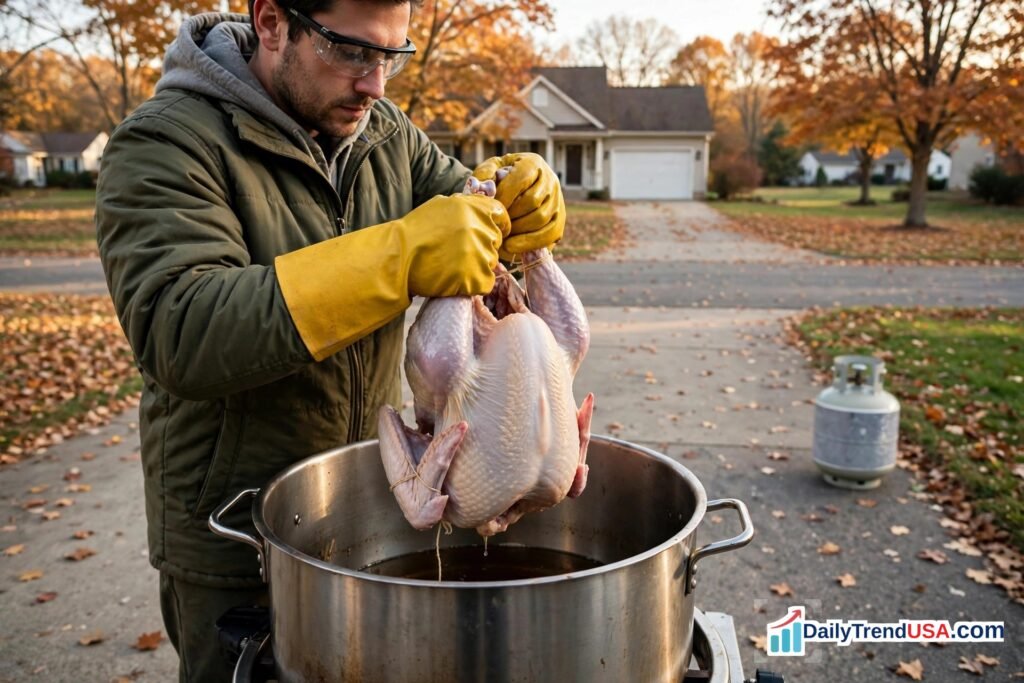
Standfirst: A deep-fried turkey cooks fast and comes out crisp, but the fryer behind it is one of the riskiest pieces of cooking equipment in an American home. The National Fire Protection Association discourages the use of outdoor gas-fueled turkey fryers, and fryer fires cause more than $15 million in property damage every year. Thanksgiving is the peak day for home cooking fires, with three times the average number of reported home fires involving cooking equipment. If you fry a turkey this year, these nine rules are the difference between dinner and a disaster.
Key facts
| Fact | Detail |
|---|---|
| Oil temperature | Heat oil to 350°F and keep it there; oil can ignite at 375°F |
| Cook time | About 3 to 5 minutes per pound, per the U.S. Department of Agriculture |
| Safe internal temperature | 165°F in the thickest part of the breast and the innermost thigh and wing |
| Best turkey size for frying | 12 pounds or less, never stuffed |
| Fryer distance from the house | More than 10 feet away, outdoors on flat ground, never in a garage or on a deck |
| Property damage from fryer fires | More than $15 million a year, per the National Fire Protection Association |
| Thanksgiving cooking fires | Three times the average day, the peak day of the year for home cooking fires |
| If a grease fire starts | Never use water; get out and call 911 |
Why a turkey fryer is so dangerous
A turkey fryer is a large pot of oil, three gallons or more, heated by an open propane flame to 350 degrees. That combination is the problem. The pot tips easily. The oil has no thermostat on many units, so it can keep heating past its safe temperature until its vapors catch fire. And the turkey itself is the trigger: a bird that is still frozen or even partly frozen drops ice and water into 350-degree oil, which turns to steam in an instant and throws burning oil out of the pot.
The National Fire Protection Association discourages the use of outdoor gas-fueled turkey fryers for exactly these reasons, and Underwriters Laboratories, the organization that certifies safe products, does not certify these fryers with its UL mark. Tests have shown the units have a high risk of tipping over, overheating, or spilling hot oil, which leads to fires, burns, or other injuries.
That does not mean nobody fries a turkey. It means the margin for error is small, and every shortcut adds risk. The rules below come from the U.S. Department of Agriculture, the National Fire Protection Association, and state fire marshals. They are not suggestions. They are the steps that keep a fryer from becoming a fire.
Rule 1: Thaw the turkey completely, then dry it
A frozen turkey is the single most dangerous thing you can put in a fryer. Ice and water turn to steam the moment they hit hot oil, and the steam expands fast enough to push burning oil over the sides of the pot. The U.S. Department of Agriculture says a turkey must be completely thawed before it goes into a fryer, and the National Park Service fire guidance puts it bluntly: make sure the turkey is completely thawed to prevent a fire or explosion hazard.
Thawing takes planning. A turkey needs about 24 hours in the refrigerator for every four to five pounds, so a 12-pound bird needs roughly three days. If you are short on time, a cold-water thaw works faster, about 30 minutes per pound, with the water changed every half hour. Either way, check the inside cavity for ice before you start. Our Thanksgiving food safety guide walks through thawing times and how to handle leftovers once the meal is over.
Drying matters as much as thawing. Pat the bird dry inside and out with paper towels before it goes near the oil. Even a wet bird will make the oil bubble hard and spill. A dry bird goes in calmly.
Rule 2: Pick the right size and never stuff it
The U.S. Department of Agriculture says a whole turkey for deep frying should be 12 pounds or less, and it must not be stuffed. A bigger bird does not fit the pot safely, and stuffing blocks heat from reaching the center, so the outside burns while the inside stays undercooked.
If you are feeding a large crowd, fry two smaller birds instead of one big one. It takes a little longer, but each bird cooks evenly and each one fits the pot with room to spare. The 12-pound limit is not a guess. It is the size the pot and the oil volume were designed for.
Rule 3: Measure the oil before you heat it
Overfilling is the most common fryer mistake. When the turkey goes in, it pushes the oil level up. If the pot was already full, the oil spills over the sides, runs down onto the open flame, and the whole unit catches fire.
Measure first, with cold water, before any heat is involved. Put the thawed turkey in the empty fry pot and add water until it covers the bird by about half an inch. Take the turkey out and mark the water level on the pot. Pour the water out, dry the pot completely, and fill the oil to that mark. That is the right amount of oil for your bird. Most home fryers use three gallons or more, so buy enough oil and do not guess.
Rule 4: Set up outside, far from the house
A turkey fryer belongs outdoors, on flat and level ground, more than 10 feet from the house. Never use one indoors, in a garage, on a porch, on a deck, or under any structure that can catch fire. The National Fire Protection Association guidance is absolute on this point, and fire departments repeat it every year because people still break it.
Pick a spot with nothing overhead and nothing flammable nearby. Keep the propane tank at least two feet from the fryer, and stand upwind of the tank and the pot so heat blows away from you. Rain or snow falling into the pot will splatter hot oil, so if the weather turns, wait for another day rather than fry in a storm. Check that children and pets cannot reach the cooking area, and keep them away even after the turkey is done, because the oil stays dangerously hot for hours.
Rule 5: Lower the turkey slowly
Once the oil reaches 350 degrees, turn the burner off before the turkey goes in. Lower the bird into the pot very slowly, using the basket or the hook that came with the fryer. A slow lower lets the oil settle instead of surging over the sides. If the oil starts to bubble hard, pause and hold the bird steady until it calms down.
Wear long protective gloves and safety glasses for this step. The lid and the handles get extremely hot, and a splash of 350-degree oil causes a serious burn in a second. Roll your sleeves up and tuck away loose clothing so nothing dangles near the flame or the oil. Then turn the burner back on and keep the oil at 350 degrees.
Rule 6: Watch the temperature and never walk away
A fryer with no thermostat will keep heating until the oil smokes and catches fire. Clip a thermometer to the side of the pot and watch it through the whole cook. Keep the oil at 350 degrees. If it starts to smoke, turn the gas off right away. Oil can ignite at 375 degrees, so there is very little room between cooking temperature and fire.
Never leave the fryer unattended, not for a minute. Unattended cooking is the leading contributing factor in cooking fires and deaths, and a pot of hot oil is the worst thing to walk away from. Stay with it from the first minute to the last.
Rule 7: Time it, then check the temperature
The U.S. Department of Agriculture says to allow about 3 to 5 minutes of cook time per pound at 350 degrees. A 12-pound turkey takes roughly 36 to 60 minutes. Use that as a planning figure only. The clock does not decide when a turkey is done. The thermometer does.
Lift the turkey out of the oil and drain the oil from the cavity. Check the temperature with a food thermometer in the thickest part of the breast and the innermost part of the thigh and wing. The turkey is safely cooked when it reaches a minimum internal temperature of 165 degrees in all three spots. Do not test the temperature while the turkey is still in the oil. If it has not reached 165 degrees, put it back in for a few more minutes and check again.
Let the turkey rest for about 20 minutes before carving. The rest lets the juices settle and the temperature even out.
Rule 8: Know what to do if the oil catches fire
If a grease fire starts, never use water on it. Water turns to steam, throws burning oil in every direction, and makes the fire worse. If the fire is small and you have a multipurpose dry-powder fire extinguisher within reach, use it. Keep one beside the fryer before you start cooking, not inside the house.
If the fire is growing or you are not sure you can control it, get out and stay out. Call 911 once you are safely away from the house. Do not go back inside for anything. A fryer fire can spread to a deck, a garage, or a house in minutes, and no turkey is worth that risk.
Rule 9: Let the oil cool completely before you touch it
The oil stays dangerously hot for hours after the burner goes out. Do not move the pot, pour the oil, or clean up while it is still hot. Let it cool completely first. Once it is cool, strain the oil through cheesecloth into a container, cover it, and refrigerate it if you plan to reuse it. Throw it away if it smells burnt or looks dark.
Wipe down the fryer and store it dry. A pot left with old oil in it turns rancid and becomes a fire risk the next time it is heated.
Holiday fire safety does not stop at the fryer
Thanksgiving is the peak day of the year for home cooking fires, but the risk does not end when the turkey is carved. The same week brings other fire hazards into the house. A Christmas tree that is not watered dries out fast, and a dry tree can catch fire in seconds, so our Christmas tree safety guide covers how to keep it watered and where to place it. Space heaters come out as the weather turns cold, and they cause their own share of fires, so our space heater safety rules explain the three-foot rule and why a heater should never run unattended.
Cooking, heating, and holiday decorations all share the same lesson: the danger is not the equipment, it is the moment nobody is watching it. Stay in the kitchen while food is on the stove, keep anything flammable away from burners, and check smoke alarms before the holiday crowd arrives. A fried turkey is a fine centerpiece. It should never be the reason the fire department comes to dinner.
Sources
- U.S. Department of Agriculture, “Don’t Make Turkey Frying a Disastrous Situation This Thanksgiving”: https://www.usda.gov/node/20489
- U.S. Department of Agriculture, Food Safety and Inspection Service, “Deep Fat Frying and Food Safety”: https://www.fsis.usda.gov/es/node/3352
- National Park Service, “Fire Prevention 52: Deep Fried Danger”: https://www.nps.gov/articles/p52-deep-fried-turkey-fire-safety.htm
- Oklahoma Insurance Department, “NFPA Warns of Deep-Frying Turkey Dangers”: https://www.oid.ok.gov/getready11_2019/
- Prince William County Fire and Rescue System, “Turkey Frying: Take Necessary Precautions”: https://www.pwcva.gov/assets/2021-09/TURKEY%20FRYING_0.pdf