Standfirst: A winter storm can cut off heat, power and roads for days, and the time to gather supplies is before the snow starts. A winter storm emergency kit is simply the food, water, warmth and tools your household would need to stay safe at home for at least three days without power, plus a smaller kit for the car. Here is what to pack, how much to store, and how to keep it ready.
Key facts
| Fact | Detail |
|---|---|
| Water | 1 gallon per person per day, at least a 3-day supply |
| Food | At least a 3-day supply of non-perishable food per person |
| Home kit location | One easy-to-find spot every adult in the home knows |
| Car kit location | In the trunk, packed before winter driving season starts |
| Check the kit | At least twice a year, and before every winter storm season |
| Power | Flashlights, a battery radio and extra batteries, not candles |
| Warmth | Blankets or sleeping bags, one per person, plus extra layers |
| Gas tank | Keep the car tank at least half full in winter |
Start with water and food
Water comes first in any emergency kit. The American Red Cross and the Federal Emergency Management Agency recommend storing one gallon of water per person per day, with at least a three-day supply for each person in the household. Half of that is for drinking and half is for food preparation and basic washing. Store the water in plastic containers such as soft drink bottles, and avoid containers that can break, like glass bottles.
Food is next. Keep at least a three-day supply of non-perishable food that needs no refrigeration, no cooking, and little or no water. Canned fruit, canned vegetables, peanut butter, crackers, granola bars, dried fruit and nuts all work well. Pick foods your family will actually eat, and include a manual can opener if any of the cans need one.
Do not forget the people and animals with special needs. Babies need formula and diapers. Anyone who takes prescription medicine needs extra doses in the kit. Pets need their own food and water for three days too. Ready.gov, the federal preparedness site, stresses that each person’s specific needs, including medication, should be part of the plan.
Rotate the supplies. Food and water do not last forever, so check expiration dates when you check the kit and replace anything that is close to expiring. A kit full of expired cans is no kit at all.
Warmth, light and power
A winter storm often means a power outage, and a power outage in freezing weather is a warmth problem first. Pack one real blanket or sleeping bag per person, plus hats, gloves and extra layers of warm clothing. The Red Cross advises keeping a warm coat, gloves or mittens, a hat, water-resistant boots and extra blankets for each member of the household close at hand.
For light, pack flashlights or LED lanterns, one per person if you can, with extra batteries in several sizes. Use flashlights, not candles, for light during an outage. Candles are a fire risk, and a house full of people moving around in the dark is the wrong place for an open flame.
A battery-powered or hand-crank radio, ideally a NOAA weather radio, belongs in the kit too. When the power and cell service go down, the radio is how official alerts and instructions reach you. Ready.gov also recommends keeping extra batteries for radios and flashlights as a basic step.
A portable phone charger or power bank, kept charged, is worth adding. It will not run the house, but it will keep a phone alive long enough to check alerts and call for help. Charge it when you check the kit, not when the storm is already on the way.
First aid and medicines
Assemble a first aid kit for the home and a smaller one for each car. The Red Cross disaster supplies list includes sterile adhesive bandages in assorted sizes, safety pins, soap or cleansing agent, latex gloves, sunscreen, triangular bandages and non-prescription drugs such as pain relievers. Add any prescription medicines your household needs, with a written list of what each person takes and the dose.
Keep a paper copy of important health information in the kit as well: allergies, blood type, doctor names and phone numbers, and the location of the nearest hospital and urgent care clinic. If the power is out, a phone with a dead battery cannot look any of that up.
Check expiration dates on medicines and first aid supplies every time you check the kit. Replace anything that has expired, and restock anything you used during the year. A first aid kit is only useful if it is complete when you need it.
Documents and everyday essentials
Put copies of important documents in a waterproof bag or container inside the kit: identification, insurance policies, birth certificates, a list of emergency contacts and the account numbers you would need if you had to leave home in a hurry. Keep the originals somewhere safe and dry, and keep the copies where you can grab them.
A small amount of cash in small bills is worth including. If the power is out, card readers and cash machines may not work, and a storm is a bad time to find that out. The amount does not need to be large, just enough for fuel, food or a phone call.
Add the everyday items that are easy to forget: a multi-tool or basic tools, duct tape, plastic bags for sanitation, paper towels, moist towelettes, garbage bags and a whistle to signal for help. A deck of cards or a small game helps pass the time if the power is out for hours, especially with children in the house.
The car kit
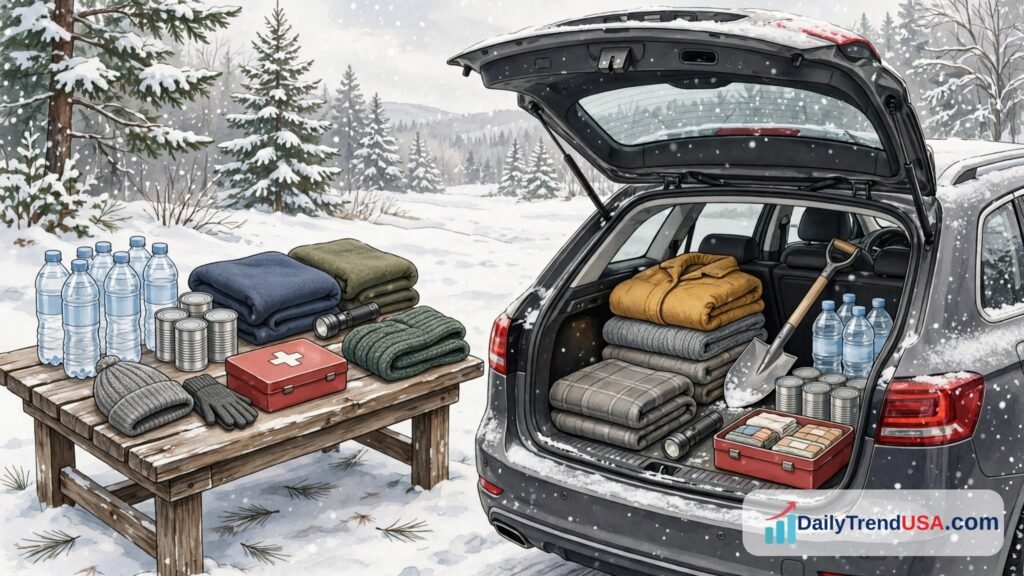
The car needs its own kit, kept in the trunk through the winter. Ready.gov says to create an emergency supply kit for your car that includes jumper cables, sand, a flashlight, warm clothes, blankets, bottled water and non-perishable snacks, and to keep a full tank of gas.
The Red Cross adds more detail. Its winter driving guidance recommends a windshield scraper and small broom, a compact shovel, a small sack of sand or non-clumping kitty litter for traction under the wheels, tire chains or traction mats, matches in a waterproof container, a brightly colored cloth, preferably red, to tie to the antenna, and an emergency contact card with names and phone numbers.
Pack high-protein snacks and water, a first aid kit, a flashlight, a small battery-operated radio, extra prescription medications, blankets and important documents or information you may need. Bring enough for each person who usually rides in the car, not just the driver.
Keep the gas tank at least half full all winter. A full tank lets you leave right away in an emergency, keeps the fuel line from freezing, and gives you heat if you are stuck in traffic or stranded. If you are trapped in your car during a storm, stay inside the vehicle, run the engine only in short bursts for heat, and make sure the exhaust pipe stays clear of snow so carbon monoxide cannot build up inside.
Where to store it and how to keep it ready
Store the home kit in one convenient place that every family member knows, and keep a smaller version in the trunk of the car. A large covered trash container, a camping backpack or a duffle bag all work as containers. The point is that anyone in the house can find it in the dark, without a search.
Check the kit at least twice a year, and again before the winter storm season starts. Replenish anything missing or in short supply, especially medications and medical supplies. Test the flashlights, charge the power bank, check the radio batteries and replace the water if the containers are old.
Make the check a household habit. Pick two dates that are easy to remember, such as when the clocks change in spring and fall, and go through the kit on those days. The habit matters more than the date. A kit that was perfect two years ago and has not been touched since is not a plan.
Winter weather is arriving now. Freeze warnings covered 157 counties across Missouri, Illinois and Kansas this week, and a coastal storm is spreading snow from the Southeast to New England this weekend. Our guide explains how the freeze warnings are hitting the Midwest, and our separate guide covers how to prepare your home for freezing weather room by room. If the power goes out as well, see what to do when the power goes out at home.