Standfirst: You turn on a tap on a freezing morning and only a trickle comes out, or nothing at all. A frozen pipe is the likely cause, and it is more than an inconvenience. Water expands as it freezes, and that pressure can split a pipe and flood your home. Here is how to tell a pipe is frozen, how to thaw it safely, and when to call a plumber.
Key facts
| Fact | Detail |
|---|---|
| First warning sign | A faucet gives only a trickle, or no water at all |
| Why pipes burst | Water expands as it freezes and puts pressure on the pipe |
| Pipes most at risk | Outdoor taps, pipes on exterior walls, and pipes in unheated spaces |
| Safe thawing tools | Hair dryer, electric heating pad, hot-water towels, space heater |
| Never use | Blowtorch, kerosene or propane heater, charcoal stove, open flame |
| If you cannot thaw it | Call a licensed plumber |
| If a pipe bursts | Shut off the main water supply right away |
| Prevention | Drip faucets, open cabinet doors, keep heat on, insulate pipes |
How to tell a pipe is frozen
The most common sign is simple: you turn on a faucet and only a trickle comes out, or nothing comes out at all. That is the moment to suspect a frozen pipe, according to the American Red Cross.
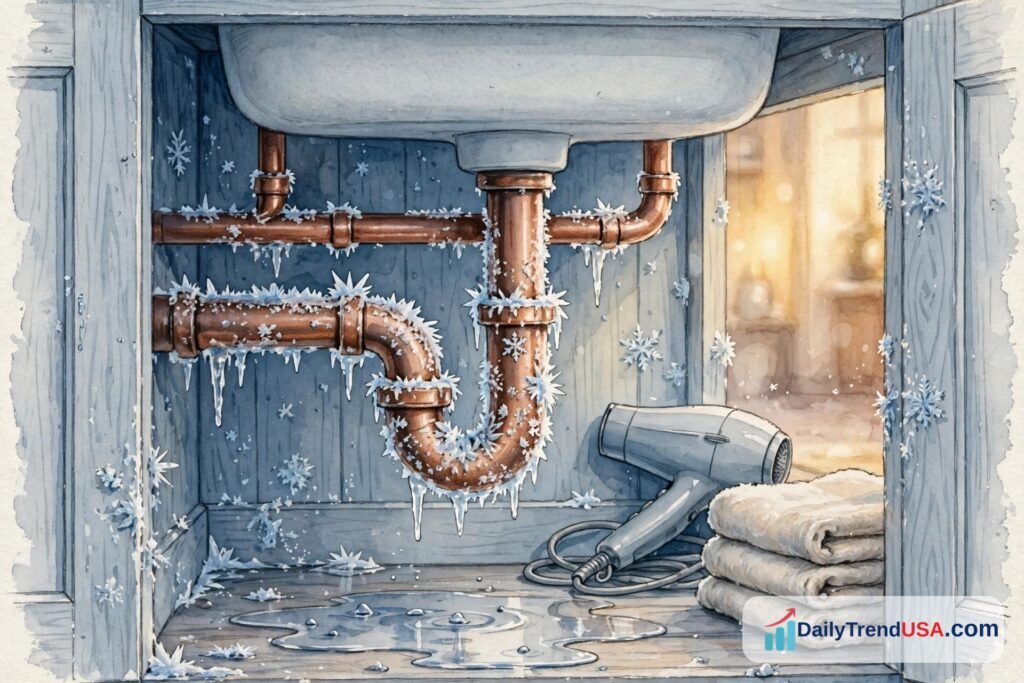
Frozen pipes are most likely in a few places. Pipes that run against exterior walls with little or no insulation freeze first. So do water supply pipes in unheated interior areas: basements, crawl spaces, attics, garages, and under kitchen and bathroom cabinets. Outdoor hose taps and sprinkler lines are also at risk. Another common spot is where the water service enters your home through the foundation.
Check the other faucets in your home too. If one pipe has frozen, others may have frozen as well. Finding every frozen pipe now saves a second surprise later.
Cold alone does not always mean a burst. A pipe can freeze solid and still survive, but only if the ice is thawed before the pressure builds enough to split the pipe. That is why acting quickly matters, and why the thawing method matters even more.
What to do first
Start with the faucet. Keep the faucet open while you work on the frozen pipe. As the frozen area begins to melt, water will start to flow through it, and running water helps melt the rest of the ice. An open faucet also gives the pressure somewhere to go, which lowers the chance of a burst.
Next, try to find the frozen section. Feel along the pipe for a spot that is much colder than the rest, or look for frost on the outside of the pipe. The frozen section is usually near an exterior wall, in an unheated space, or where the pipe enters the house.
If you see water leaking or spraying, or if a pipe has already split, the job has changed: shut off the main water supply right away. Find your main shut-off valve before cold weather arrives, and show every adult in the home where it is. Shutting off the water in the first minutes after a burst can save thousands of dollars in damage. Once the water is off, open the faucets to drain what is left in the pipes, and call a plumber.
Do not wait to see if the problem fixes itself. A frozen pipe will not thaw on its own while the temperature stays below freezing, and every hour of pressure raises the risk of a split.
How to thaw a frozen pipe safely
Apply heat to the frozen section of pipe, and be patient. The Red Cross recommends four safe tools: an electric heating pad wrapped around the pipe, an electric hair dryer, a portable space heater kept away from flammable materials, or towels soaked in hot water wrapped around the pipe. Any of these will work. Pick the one that fits the space.
Start thawing near the faucet and work back toward the frozen section, so the melting water has somewhere to go. Keep the faucet open the whole time. Apply heat until full water pressure is restored. Do not stop at the first trickle. The pipe may still be partly blocked further along.
Never use an open flame. Do not use a blowtorch, a kerosene or propane heater, a charcoal stove, or any other open-flame device to thaw a pipe. Open flames can start a fire, damage the pipe, and release carbon monoxide. This is the single most important safety rule in the whole job, and it is the one people break most often when they are in a hurry.
If you are using a space heater, keep it away from curtains, bedding, towels and anything else that can catch fire, and never leave it running unattended. Our guide explains how to use a space heater safely this winter.
When to call a plumber
Some frozen pipes are a job for a professional. Call a licensed plumber if you cannot locate the frozen area, if the frozen area is not accessible, or if you cannot thaw the pipe with the safe methods above. A plumber has the tools to find a frozen section inside a wall and thaw it without opening the wall up more than necessary.
Call a plumber right away if a pipe has burst or is leaking and you have shut off the water. A burst pipe needs a repair, not just a thaw, and the longer the water sits, the more damage it does to floors, walls and belongings.
Also call for help if the water pressure does not come back fully after thawing, or if the water looks dirty or smells odd when it returns. Those can be signs of a crack or a second frozen section further along the line.
What not to do
A few mistakes turn a frozen pipe into a flooded house.
Do not use an open flame. Blowtorches and propane heaters are the most common cause of fires during pipe-thawing attempts, and they can crack a pipe as well as burn a house.
Do not pour boiling water straight onto a frozen pipe. Sudden, extreme heat can crack metal and plastic. Hot towels and a hair dryer are slower, but they warm the pipe evenly and safely.
Do not leave a thawing pipe unattended. Stay with it until the water is flowing at full pressure. If the pipe splits while you are in another room, the water can run for a long time before anyone notices.
Do not ignore the other faucets. If one pipe froze, check them all. A second frozen pipe that goes unnoticed can burst later, after you have already fixed the first one.
Do not turn the heat off to save money during a cold snap. Keeping the thermostat at the same temperature day and night costs a little more in heating, but a burst pipe costs far more. If you leave the house in cold weather, leave the heat on at no lower than 55 degrees Fahrenheit.
How to keep it from happening again
Once the pipe is thawed and the water is flowing, take the prevention steps that stop a repeat. Our guide explains how to prepare your home for freezing weather room by room, and the pipe steps are the most important part of it.
Insulate exposed pipes. Pipes on exterior walls, in garages, attics and crawl spaces should be wrapped with pipe insulation. Both hot and cold water pipes in these areas need it. Products made for the job, such as pipe sleeves or UL-listed heat tape, work best.
Let faucets drip on very cold nights. Running water through a pipe, even at a trickle, helps prevent freezing. The drip matters most for faucets served by exposed pipes.
Open cabinet doors. On cold nights, open the cabinet doors under kitchen and bathroom sinks so warm air can reach the pipes. Move any harmful cleaners and household chemicals up out of the reach of children first.
Seal drafts near pipes. Cold air comes in through small gaps around doors and windows, and pipes near those gaps freeze first. Our guide to winter-proofing windows and doors covers the sealing steps.
Know your shut-off valve. Before the next cold snap, find the main water shut-off valve and make sure every adult in the home knows where it is and how it works. It is the one thing you need in a hurry if a pipe ever bursts.
If a winter storm knocks out your power as well, the risk rises fast: no heat means pipes can freeze in hours, so a power outage during a freeze deserves the same urgency as the frozen pipe itself.