

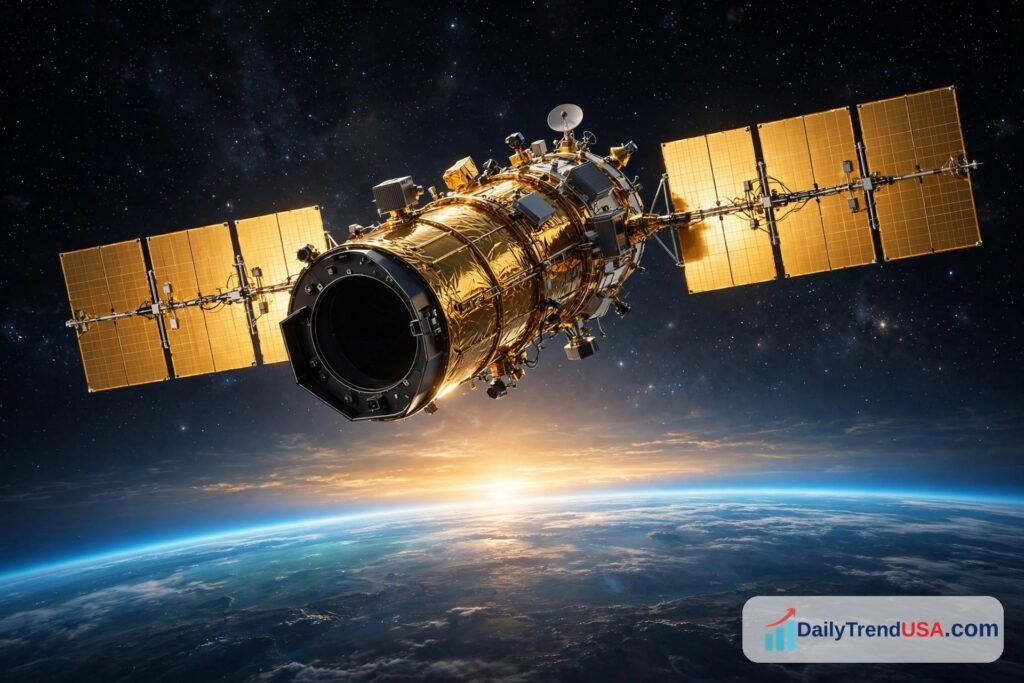
Standfirst: NASA’s Neil Gehrels Swift Observatory re-entered Earth’s atmosphere on Wednesday, Nov. 4, 2026, over Indonesia, ending nearly 22 years in orbit. Here is what happened, why the telescope fell, and what it found during its long life in space.
What happened
Re-entry: NASA’s Neil Gehrels Swift Observatory fell back to Earth on Wednesday, Nov. 4, 2026, burning up as it re-entered the atmosphere. The re-entry took place at 7:39 a.m. EST (12:39 UTC) over the North Sumatra region of Indonesia, at about 3.4 degrees north latitude and 98.6 degrees east longitude.
Confirmed: The re-entry was confirmed by tracking data from the U.S. Space Force and confirmed by NASA. The telescope, known to astronomers simply as Swift, had been in orbit since it launched in November 2004, so it spent nearly 22 years circling the Earth before its final descent.
The telescope: Swift weighed 3,200 pounds (1.5 metric tons) and was built to study gamma-ray bursts — sudden, powerful flashes of energy from distant parts of the universe. Over its long career it became one of the most productive space telescopes ever flown, and its loss marks the end of an era for the scientists who relied on it.
Remote location: The telescope’s final days were closely watched. NASA had been tracking its sinking orbit for months, and the agency had already ended the mission weeks before the re-entry. When Swift finally came down, it did so over a remote stretch of ocean and land in western Indonesia, far from crowded cities.
A 22-year mission in numbers
Nearly 22 years: Swift’s career lasted nearly 22 years, from its launch in November 2004 to its re-entry on Nov. 4, 2026. Few space telescopes stay in service for that long, and Swift kept working far beyond the length of time it was first expected to last.
- Launched: November 2004
- Re-entered: Nov. 4, 2026, at 7:39 a.m. EST (12:39 UTC)
- Time in orbit: Nearly 22 years
- Weight: 3,200 pounds (1.5 metric tons)
- Gamma-ray bursts detected: More than 2,000
- Re-entry location: North Sumatra region, Indonesia — about 3.4 degrees north latitude, 98.6 degrees east longitude
Named for Neil Gehrels: The telescope was named for astronomer Neil Gehrels, who led the project and helped shape its science goals. Gehrels died in 2017, but the telescope kept his name and kept working for nearly a decade after his death.
Final days: Swift made its last observation on Oct. 20, 2026, just two weeks before it fell. NASA formally ended the mission on Oct. 23, 2026, once it was clear the telescope could no longer hold a steady orbit. By then, Swift’s orbit had sunk below about 171 miles (275 km) above the Earth — too low for the telescope to stay in space much longer.
A record career: The numbers tell the story of a mission that did far more than anyone planned. More than 2,000 gamma-ray bursts detected, nearly 22 years of observations, and a steady stream of data that astronomers around the world used to study the most violent events in the universe.
Why Swift fell back to Earth
A slow sinking: Swift did not fall because of a sudden failure. It fell because its orbit had been slowly sinking for years, and the final drop came faster than expected.
Solar activity: The cause was increased solar activity. Over the past two years, the Sun has been more active, and that activity has puffed up Earth’s upper atmosphere. A thicker upper atmosphere means more drag on anything orbiting low above the Earth, and more drag means a faster loss of height.
Too low to hold: Swift’s orbit had already sunk below about 171 miles (275 km) by the time NASA ended the mission on Oct. 23, 2026. At that height, the drag from the puffed-up atmosphere was too strong for the telescope to hold steady. Once an orbit sinks that low, the descent speeds up: each pass through the thicker air slows the spacecraft a little more, which lowers its orbit further, which brings it into even thicker air.
A normal fate: This is a normal fate for satellites in low orbit. Without a way to boost itself higher, any spacecraft in that part of space will eventually be pulled down by drag. Swift had no fuel left to raise its orbit, and no other way to climb back to a safe height.
Watched to the end: NASA watched the descent closely in the final weeks. The agency knew the telescope was coming down, and the only question was exactly when and where. The answer came on the morning of Nov. 4, 2026, when Swift re-entered over Indonesia.
The rescue that did not work
A rescue attempt: NASA did not simply watch Swift fall. In the summer of 2026, a rescue attempt was made to save the telescope and push it into a safer orbit.
The LINK spacecraft: The rescue was carried out by a commercial robotic spacecraft called LINK. The plan was for LINK to meet Swift in orbit and raise it to a higher, safer path, where the drag from the upper atmosphere would be weaker and the telescope could keep working.
Steering lost: The plan failed. LINK lost steering during the attempt, and it had to spend fuel regaining control of itself. By the time it had steadied, it no longer had the fuel it needed to complete the rescue. LINK itself then re-entered Earth’s atmosphere in September 2026, about two months before Swift followed it down.
No way out: The failed rescue left Swift with no way out. Its orbit kept sinking through the autumn, and NASA ended the mission on Oct. 23, 2026. The telescope made its last observation on Oct. 20, 2026, three days before the mission was formally closed.
A bold idea: The LINK attempt was a bold idea: using a commercial robot to save a working telescope instead of letting it fall. It did not work this time, but the attempt showed how space agencies are now willing to try new ways to extend the life of valuable spacecraft.
What the telescope discovered
Built to hunt bursts: Swift was built for one job: to find and study gamma-ray bursts. These are sudden, intense flashes of energy that come from far away in the universe, and they are among the most powerful events known to science.
More than 2,000 bursts: Swift did that job better than any telescope before it. In nearly 22 years in orbit, it detected more than 2,000 gamma-ray bursts — a record that made it the most successful burst-hunting telescope ever flown. Each detection gave astronomers a chance to study an event that may have lasted only seconds but carried clues about the deaths of stars and the birth of black holes.
Speed was its strength: The telescope’s speed was its great strength. When a burst went off, Swift could turn toward it quickly and record the fading light that followed. That fast response let scientists on the ground point other telescopes at the same spot and learn far more than they could from the burst alone.
Beyond bursts: Over the years, Swift’s work went beyond gamma-ray bursts. The telescope also watched other violent and changing objects in the sky, and its long, steady stream of data became a resource for astronomers around the world. Its 2,000-plus burst detections are now part of the permanent record of how the universe behaves at its most extreme. For a sense of how modern sky-watching works, see how the Webb telescope studied the interstellar comet 3I/ATLAS, and the report of a possible new dwarf planet found beyond Pluto.
A lasting legacy: The telescope’s legacy will live on in the data it collected. Even though Swift is gone, the observations from its nearly 22 years in orbit will keep being studied for years to come — including by scientists tracking how space weather, covered in the NOAA winter outlook, affects the world below.
What happens to the debris
Mostly burned up: When a spacecraft the size of Swift re-enters the atmosphere, most of it burns up from the heat of the descent. NASA expected most of Swift to burn up, but the agency also said that some durable components may have survived re-entry and reached the ground.
No debris found: As of now, no debris was reported found. The re-entry took place over the North Sumatra region of Indonesia, and no reports of fallen wreckage have come in. That is common for re-entries over remote areas, where debris can fall into the sea or into thick forest and never be found.
Low risk: NASA estimated the chance of falling debris harming anyone at about 1 in 2,100. That is a low risk, but not zero, which is why the agency tracks re-entries closely and shares the expected path in advance. The risk was judged low enough that no special warnings were needed for people on the ground.
The end of Swift: The end of Swift is a reminder that everything put into low orbit eventually comes back down. The telescope spent nearly 22 years above the Earth, detected more than 2,000 gamma-ray bursts, and then, in a few minutes on the morning of Nov. 4, 2026, it was gone. What remains is the science it left behind — and the knowledge that even a mission as long-lived as Swift cannot outrun the pull of Earth’s atmosphere forever.