Standfirst: The U.S. Food and Drug Administration has raised the recall of frozen organic berries sold at Walmart and Trader Joe’s to Class I, its highest risk level, after linking the products to an E. coli O145 outbreak that sickened 17 people and sent six to the hospital. About 154,000 bags are covered, and with best-by dates running into 2028, some bags may still be sitting in home freezers now.
What we know / What we don’t know
What we know:
- On Thursday, November 19, 2026, the FDA designated the three recalled frozen berry products as Class I recalls, its highest risk level, for potential E. coli O145:H28 contamination.
- The products are Great Value Organic Triple Berry Blend 10 oz, Great Value Organic Blueberries 10 oz, and Trader Joe’s Organic Mixed Berry Blend 12 oz, packed by Frutas y Hortalizas del Sur S.A. of San Carlos, Chile. About 154,000 bags are covered in total.
- The outbreak behind the recall sickened 17 people in Florida and Georgia, with illnesses reported from May 11 to August 2, 2026. Six people were hospitalized. No deaths were reported, and the CDC declared the outbreak over on September 21, 2026.
- The recalled bags carry best-by dates from January 2028 through June 2028, so they can still be in home freezers. The FDA says recalled products should no longer be on store shelves.
What we don’t know:
- How many recalled bags are still in home freezers. The FDA says shoppers should check their homes, but no count exists.
- How the berries became contaminated. Traceback work linked the recalled lots to frozen blueberries at the center of the first recall in July, but the FDA record does not name a route.
- Whether any new illnesses have appeared since the outbreak was declared over. The CDC reported no new illnesses after September 21, and the Class I decision reflects the risk level of the products, not a new case count.
- Whether Walmart or Trader Joe’s have sent their own notices to shoppers beyond the FDA posting. Neither company’s own notice appears in the sources reviewed.
Key facts
| Detail | Confirmed |
|---|---|
| Risk level | Class I, the FDA’s highest risk classification, designated November 19, 2026 |
| Products | Great Value Organic Triple Berry Blend 10 oz; Great Value Organic Blueberries 10 oz; Trader Joe’s Organic Mixed Berry Blend 12 oz |
| Bags recalled | About 154,000 |
| Contaminant | E. coli O145:H28, a Shiga toxin-producing E. coli |
| People sickened | 17 in Florida and Georgia |
| Hospitalized | 6 |
| Deaths | 0 reported |
| Illness dates | May 11 to August 2, 2026 |
| Outbreak status | Declared over September 21, 2026 (CDC) |
| Supplier | Frutas y Hortalizas del Sur S.A., San Carlos, Chile |
Which bags are recalled
A bag is covered only when its product name, size and lot code all match. Check the front of the bag for the Great Value products and the back for the Trader Joe’s product.
The Great Value Organic Triple Berry Blend, 10 oz, includes strawberries, blackberries and blueberries. Its UPC is 7874211226, and the recalled lot codes are 6 031 01 and 6 041 01. The best if used by dates are January 31, 2028 and February 10, 2028.
The Great Value Organic Blueberries, 10 oz, carry UPC 7874211213. The recalled lot codes are 6 019 01, 6 040 01 and 6 163 01, with best if used by dates of January 19, 2028, February 9, 2028 and June 12, 2028.
The Trader Joe’s Organic Mixed Berry Blend, 12 oz, includes strawberries, blackberries, blueberries and raspberries. Its UPC is 00977654, and the recalled lot code is 6 051 01, printed on the back of the bag. The best before date is February 20, 2028.
The Great Value products were shipped to select Walmart stores in 30 states and Puerto Rico. The Trader Joe’s product went to stores in 26 states and Washington, D.C. The full state lists are in the FDA recall notice linked in the sources below.
If the lot code on a bag does not match one of the codes above, that bag is not part of this recall. If it does match, do not eat it. Throw it away or return it to Walmart or Trader Joe’s for a full refund.
How the recall grew from July to November
It began in July 2026, when the supplier first recalled one lot of Publix GreenWise Organic IQF Blueberries after a sample tested positive for the same E. coli strain. The CDC counted 17 people infected in Florida and Georgia, with illnesses from May 11 to August 2, 2026. Six were hospitalized. No deaths were reported.
The supplier expanded the recall in September to a lot of Great Value Triple Berry Blend, then again on October 2 to the three products now listed as Class I. Each expansion followed traceback records that tied more bags to the frozen blueberries in the original July recall.
The CDC declared the outbreak over on September 21, 2026, with no new illnesses since. The recall goes on because frozen berries keep for years, and the Class I bags carry best-by dates into 2028, so the FDA is still telling shoppers to check their freezers.
This is not the first Walmart recall our readers have needed to check this fall. More than 44,000 cans of Walmart’s Great Value Fruit Cocktail were recalled over possible lead contamination, and the lot code was the detail that mattered there too.
What E. coli O145:H28 can do
E. coli O145:H28 is a Shiga toxin-producing E. coli, often called STEC. It can cause severe stomach cramps, diarrhea that may be bloody, and vomiting, plus fever and nausea. Symptoms usually begin a few days after eating contaminated food, sometimes up to nine days later.
Most healthy people recover within a week, according to the FDA. Some infections can lead to a serious complication called hemolytic uremic syndrome, or HUS, which affects the kidneys and can be life threatening. Young children, older adults and people with weakened immune systems face the highest risk.
Anyone who ate recalled berries and feels sick should call a health care provider right away and mention the recall. Bloody diarrhea, severe stomach cramps or vomiting that will not stop all need same-day care.
What to do if you have the berries
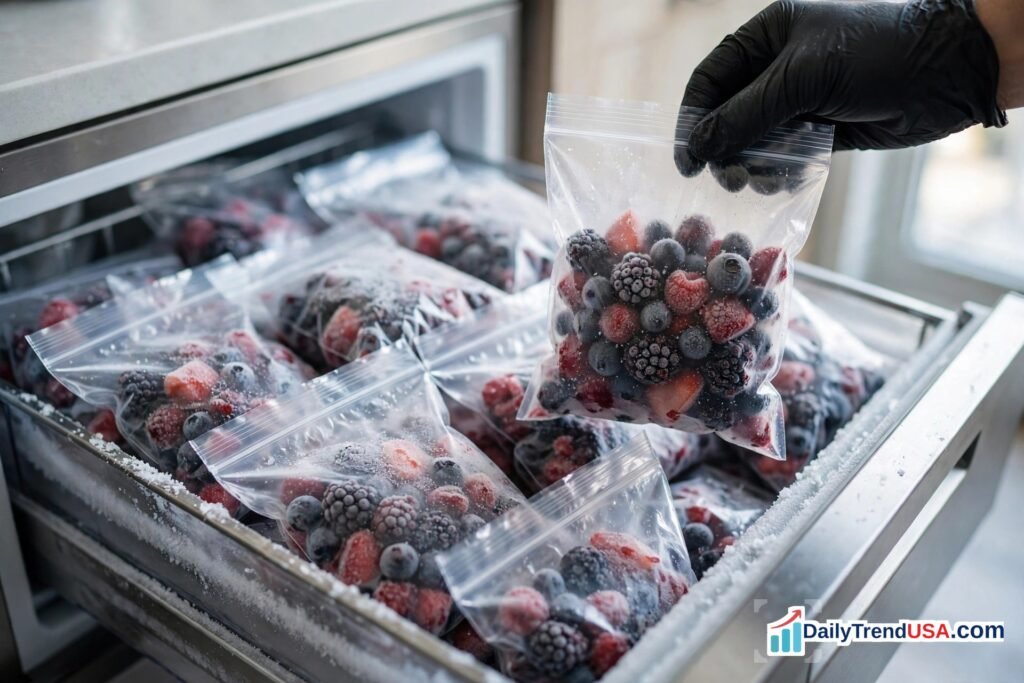
Start with the freezer. Pull out every bag of frozen organic berries from Walmart or Trader Joe’s and read the lot code. A bag that matches should not be eaten, cooked, blended into a smoothie or fed to anyone else. Discard it or return it to the store for a full refund.
If a bag matches, seal it before throwing it away so it does not leak onto other food, and wipe down the shelf where it sat. Wash your hands after handling it, and wash any container or blender that touched the berries with hot, soapy water.
If you already ate berries from a matching bag and feel fine, watch for symptoms for up to nine days. If symptoms start, call a health care provider and mention the recall. Keep the bag, or a photo of its lot code.
Shoppers with questions can contact the supplier’s media contact, Joshua Weiss, at Info.foodsafety@comfrut.com or 336-899-5612, Monday through Friday, 8 a.m. to 6 p.m. Eastern. Stores will take recalled bags back for a full refund, and a receipt is not needed for a recalled product.
Why Class I is the highest warning
The FDA sorts recalls into three classes. Class I is the top level, used when there is a reasonable probability that using or eating a product will cause serious adverse health consequences or death. Class II covers products that may cause temporary or medically reversible health problems. Class III covers products that are unlikely to cause harm.
The November 19 decision moved these three products into Class I. That does not mean new illnesses were found. It means the FDA now rates the risk from the recalled bags at the highest level, based on the outbreak strain, the hospitalizations and the best-by dates running into 2028.
The timing fits the season. Frozen berries are a pantry staple, and the weeks before Thanksgiving are when many households stock up and dig through the freezer, so a recall covering bags sold across 30 states is worth checking now.
Other recent recalls show the same pattern: the Aldi Priano tortelloni recall over botulism risk and the Family Farmstead cheddar recall over listeria both started narrow and grew as investigators traced more product. Our Thanksgiving food safety guide covers the thawing and leftover rules for the week ahead.
Sources
- U.S. Food and Drug Administration, company announcement, October 2, 2026: Frutas y Hortalizas del Sur S.A. expands recalls to include additional lots of Great Value Frozen Organic Triple Berry Blend, Great Value Frozen Organic Blueberries and one lot of Trader Joe’s Frozen Organic Mixed Berry Blend because of potential contamination with E. coli O145. https://www.fda.gov/safety/recalls-market-withdrawals-safety-alerts/frutas-y-hortalizas-del-sur-sa-expands-recalls-include-additional-lots-great-value-frozen-organic
- U.S. Food and Drug Administration, Outbreak Investigation of E. coli O145:H28: Frozen Blueberries (July 2026), updated October 5, 2026. https://www.fda.gov/food/outbreaks-foodborne-illness/outbreak-investigation-e-coli-o145h28-frozen-blueberries-july-2026
- News reports of the FDA’s November 19, 2026 Class I designation: Internewscast, “Blueberry and Berry Blend Recall Raised to Highest Risk Level”; Bio Points News, “Walmart and Trader Joe’s Frozen Berries Recall Raised to FDA Class I Over E. Coli.”