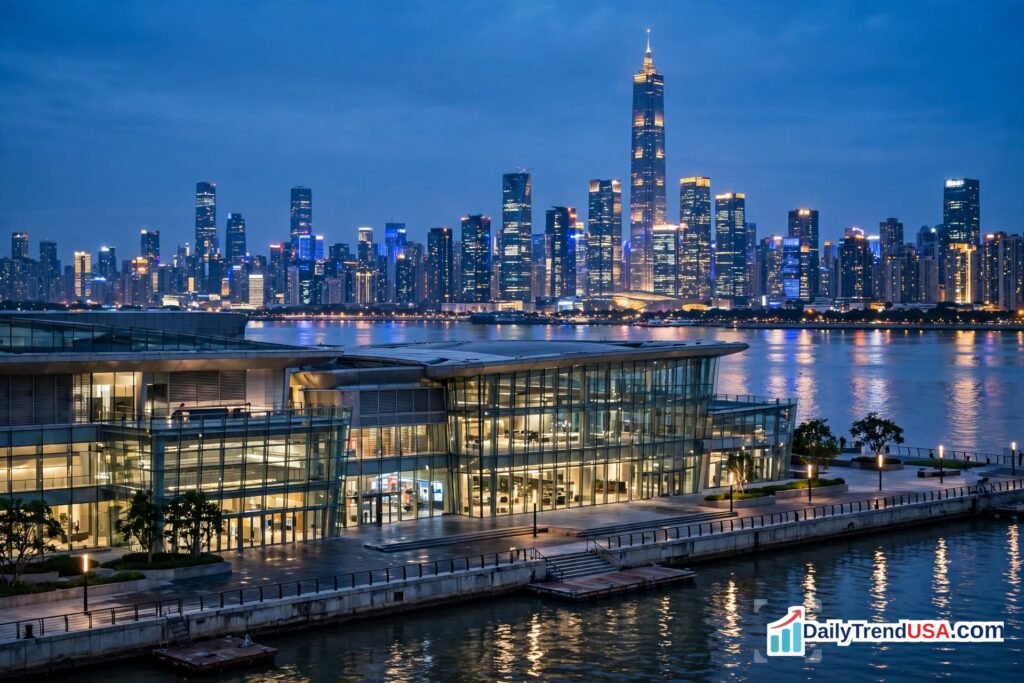
Standfirst: President Donald Trump, President Vladimir Putin of Russia and President Xi Jinping of China signed a four-point Declaration toward Peace on Thursday, November 19, after meeting in Shenzhen. The text covers United Nations reform, fuel supplies, court immunity and nuclear risk. It says nothing about Ukraine, Iran or North Korea.
Key facts
| Fact | Detail |
|---|---|
| Meeting | Trump, Putin and Xi met in Shenzhen, China, on November 19, 2026, on the sidelines of the Asia-Pacific Economic Cooperation (APEC) summit |
| Length | The talks lasted about 90 minutes, according to reports from the meeting |
| Document | A joint statement titled “U.S.-Russia-China Heads of State Declaration toward Peace,” published by the White House |
| Point 1 | Reform the United Nations so it can respond more effectively to global challenges |
| Point 2 | Increase the production and supply of refined petroleum products for all nations |
| Point 3 | State officials must keep their immunity, and the International Criminal Court must not abuse its jurisdiction |
| Point 4 | A nuclear war cannot be won and must never be fought. The three countries will hold a dialogue on reducing nuclear risks |
| What it leaves out | The text does not mention Ukraine, Iran or North Korea |
| What it is not | A treaty. The declaration is a joint statement of intent, with no binding commitments and no dates set for the next steps |
What happened in Shenzhen
The three leaders met in Shenzhen on Thursday for the first meeting of its kind. It was the first time the heads of state of the United States, Russia and China had sat down together, according to a statement from China’s foreign ministry. The meeting took place during the APEC Economic Leaders’ Meeting, which China hosted in Shenzhen.
The talks lasted about 90 minutes. Trump left for the airport immediately after the meeting ended, according to The Times. Before the talks began, Trump embraced Putin and called him “my friend” during a face-to-face meeting, The Times reported.
After the meeting, the White House published the full text of the declaration. Russia’s Foreign Ministry and China’s foreign ministry published matching versions, according to Fox News and Babypips. The Chinese statement described the theme of the meeting as “Safeguarding World Peace and Promoting Strategic Stability in Major-Country Relations.”
Xi described the meeting as positive and constructive, according to the Chinese foreign ministry readout. Putin said he wanted the talks to continue. Trump said he would hold a news conference at the White House at noon on Friday, November 20, and called the trip “Great and Highly Consequential.”
Our earlier report on the planned Shenzhen summit covered what was on the agenda before the leaders met.
The four points, in plain English
The declaration is short: an opening paragraph and four numbered points. Here is what each point says, in plain language.
1. Reform the United Nations. The United States, Russia and China are three of the five permanent members of the United Nations Security Council. In the declaration, the three countries committed to reform the UN “so that the UN can respond more effectively to global challenges and conform to its fundamental mission of international peace and security.” The text does not say what reforms the leaders have in mind, and it sets no timetable for them.
2. Raise fuel supplies. The three countries “plan to increase the production and supply of refined petroleum products for the benefit of all nations.” Refined petroleum products are fuels that have already been processed, such as gasoline, diesel and jet fuel. The leaders also “reaffirmed the importance of stable energy flows.” The declaration sets no volumes, no targets and no dates for this plan.
3. Protect state immunity. The three heads of state “recognized that the principle of state consent and respect for immunities of State officials are of paramount importance.” They agreed that the International Criminal Court and similar bodies “must not abuse their jurisdiction.” The text does not name any case or any official.
4. Talk about nuclear risk. The leaders “reaffirmed that a nuclear war cannot be won and must never be fought.” The three countries “will conduct a dialogue on reducing nuclear risks and preventing the proliferation of nuclear weapons.” The text sets no date, no venue and no agenda for that dialogue. It contains no commitment to cut nuclear stockpiles.
What the declaration leaves out
The most striking feature of the text may be what it does not say. The published declaration contains no mention of Ukraine, Iran or North Korea.
That matters because all three are live issues for the three countries. Russia’s war in Ukraine continues. The United States, Israel and Iran are in an active conflict, and the fighting has included strikes on shipping in the Strait of Hormuz. North Korea’s nuclear program remains unresolved. None of these appears in the four points.
Some early reports differed on whether Ukraine was mentioned in the talks. The text published by the White House settles that question for the written declaration: it contains no mention of Ukraine, Iran or North Korea. What the leaders discussed behind closed doors, beyond the four points, has not been published.
The omission drew quick reaction in Europe. President Emmanuel Macron of France said the declaration would not reorganize the world, according to The Times.
For context on the Middle East, the United States has been building up its military posture in the region. Our report on CENTCOM’s Task Force Iron Gate covers the US effort on Iran land routes. The declaration does not address that effort or the fighting itself.
Why it matters
A joint statement from the leaders of the three largest nuclear-armed states is rare. The United States, Russia and China hold three of the five permanent seats on the UN Security Council, and together they shape most major decisions on sanctions, peacekeeping and international law. A public statement from all three at once carries weight even when its language is general.
The nuclear point is the clearest example. “A nuclear war cannot be won and must never be fought” is language the three countries have used before, but putting it in a joint statement signed by all three leaders, on the same day, gives it fresh force. The promise of a dialogue on nuclear risk is new, even though no date has been set.
The energy point matters for a different reason. Refined fuel supplies affect prices at the pump in the United States and around the world. A pledge from the three countries to increase supply, if it leads to action, could ease pressure on fuel markets. For now, though, the declaration offers no numbers and no timetable, so its practical effect is still unknown.
The court immunity point is the most contested. The International Criminal Court has an active warrant for Putin over the war in Ukraine, and the United States has long opposed the court’s jurisdiction over its own citizens. The declaration’s language on immunity reflects positions all three governments already held. It does not change any law, and it does not bind any court. Tensions between Washington and Moscow run high on other fronts as well. The US Embassy in Moscow recently warned Americans about a threat at a Moscow park.
The UN reform point is the broadest and the least specific. All three countries agree the UN should change, but they have often disagreed about how, and the declaration does not say which reforms they support.
What happens next
Trump is scheduled to hold a news conference at the White House at noon on Friday, November 20. He is expected to discuss the trip, including the Shenzhen meeting. That news conference may provide the first detailed account from the US side of what was said in the room.
The nuclear-risk dialogue has no date. The declaration says the three countries “will conduct a dialogue,” but it does not say when, where or who will take part. Any follow-up meeting would be the first test of whether the statement leads to action.
The fuel-supply plan has no numbers. Traders and energy analysts will watch for any announcement from the three governments about production or exports. Without specifics, the pledge is difficult to measure.
The UN reform commitment has no timetable. Reform of the Security Council has been discussed for decades without agreement, and the declaration adds no new detail.
What we know
- Trump, Putin and Xi met in Shenzhen on November 19, 2026, for about 90 minutes, on the sidelines of the APEC summit.
- The three leaders signed a joint statement titled “U.S.-Russia-China Heads of State Declaration toward Peace.”
- The declaration has four points: UN reform, refined fuel supplies, state immunity and the courts, and a dialogue on nuclear risk.
- The text says a nuclear war cannot be won and must never be fought.
- The text does not mention Ukraine, Iran or North Korea.
- The White House, the Kremlin and China’s foreign ministry published matching versions of the text.
- Trump will hold a news conference at the White House at noon on Friday, November 20.
What we don’t know
- What the leaders discussed beyond the four points, since no full account of the closed-door talks has been published.
- When, where or how the promised dialogue on nuclear risk will take place.
- Whether the fuel-supply pledge will lead to any change in production or exports.
- What specific UN reforms the three countries support.
- Whether the declaration will lead to any further meetings between the three leaders.
Sources
The central facts in this article come from the White House, “U.S.-Russia-China Heads of State Declaration toward Peace,” November 19, 2026; Fox News, “Trump, Putin, Xi issue 4-point declaration after historic summit,” November 19, 2026; The Times, “Trump, Xi and Putin pledge to reform UN and boost oil production, as it happened,” November 19, 2026; Babypips, “Trump, Xi and Putin Issue a Four-Point Peace Declaration,” November 19, 2026; Just Security, “Early Edition: November 19, 2026,” November 19, 2026; and Morningstar / Dow Jones Newswires, “Dow Jones Top Company Headlines at 9 PM ET,” November 19, 2026.