

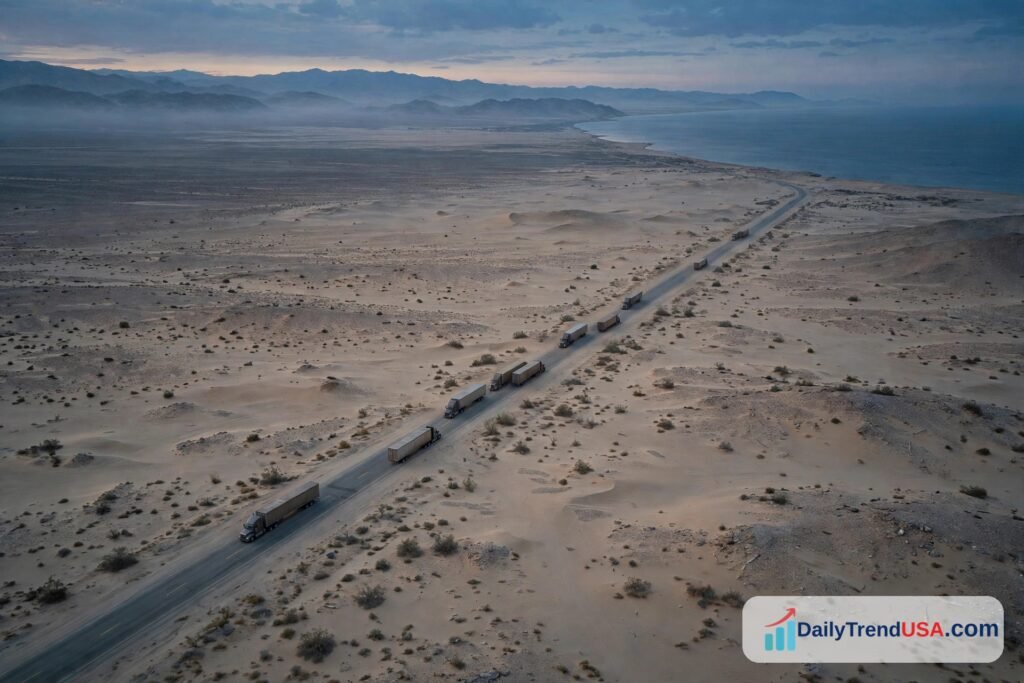
U.S. Central Command has created a new team, Task Force Iron Gate, to extend its months-long naval blockade of Iran to the country’s land borders and the Caspian Sea. The roughly 20-person unit, based in Tampa, Florida, will work with other U.S. government agencies to stop the movement of weapons and sanctioned goods by land.
What we know / What we don’t know
What we know
- On November 7, 2026, CENTCOM commander Adm. Brad Cooper directed the creation of Task Force Iron Gate.
- The task force is an internal staff of about 20 civilian and military personnel based in Tampa, Florida.
- Its job is to stop the movement of advanced weapons systems, dual-use technologies, sanctioned materials and illegal revenue streams across Iran’s land borders and the Caspian Sea.
- It extends a naval blockade that CENTCOM says has already stopped Iran from exporting more than $25 billion in crude oil in recent months. That figure is CENTCOM’s own estimate and has not been independently verified.
- Reuters reported the move first, after seeing the CENTCOM statement before its public release.
What we don’t know
- Where exactly the task force will operate, or which land crossings and routes it will focus on first.
- What legal authorities it will use, and how it will work with neighboring countries along Iran’s borders.
- Whether the team will grow beyond its current size of about 20 people, or whether any new forces will be deployed.
- How Iran will respond, and whether the land effort will change oil or weapons flows in the short term.
What Task Force Iron Gate is
Task Force Iron Gate is not a new combat deployment. CENTCOM describes it as an internal staff, about 20 civilian and military personnel, working from the command’s headquarters in Tampa, Florida. Its role is coordination and planning: it will work with other U.S. government agencies to track and disrupt the movement of restricted goods across Iran’s land borders and the Caspian Sea.
The focus, according to the CENTCOM statement, is on four things: advanced weapons systems, dual-use technologies (items that can have both civilian and military uses), sanctioned materials, and illegal revenue streams. The land routes in question link Iran to its neighbors, including Turkey, Iraq and Pakistan, and cross the Caspian Sea to the north.
CENTCOM commander Adm. Brad Cooper announced the move in a statement on Saturday. “The establishment of Task Force Iron Gate reinforces the success of our ironclad blockade against Iran at sea,” Cooper said. “Strengthening CENTCOM’s collaboration with U.S. interagency partners will further constrain Iran’s ability to finance terrorism, rebuild weapons factories, and replenish their military.”
The announcement was first reported by Reuters, which saw the CENTCOM statement before it was released publicly. Al-Monitor, Arab News and The Straits Times also reported the formation of the task force on Saturday, citing the CENTCOM statement.
Why this is an expansion, not a new campaign
The key point is that the sea blockade came first. For months, U.S. forces have enforced a naval blockade against Iran, stopping ships entering or leaving Iranian ports. CENTCOM says strict enforcement at sea continues, and that the blockade has prevented Iran from exporting more than $25 billion in crude oil in recent months.
Task Force Iron Gate takes that same effort onto land. The thinking, as set out in the CENTCOM statement, is straightforward: if pressure at sea is working, the next step is to close the land routes that could be used instead. The Caspian Sea matters here too. It is a water route, but one that sits north of Iran and connects it to Russia and the Central Asian states, outside the Gulf and Arabian Sea approaches where U.S. ships are already operating.
The statement gives no details on where the task force will operate, what authorities it will use, or how it will interact with neighboring states. It describes the unit as a coordination and planning cell, not as a deployed force. That distinction matters: this is a headquarters team that will try to connect intelligence, sanctions enforcement and partner agencies, rather than a unit sent to a border.
What the $25 billion figure means, and what it does not
The largest number in the announcement is the $25 billion in crude oil exports that CENTCOM says its naval blockade has prevented Iran from shipping in recent months. Readers should treat that figure carefully. It is the command’s own estimate, and it has not been independently verified. CENTCOM has not published the method behind it, and no outside body has confirmed it.
What the figure does show is how CENTCOM itself judges the sea blockade: as a success worth building on. The creation of a land task force is, in effect, the command saying the sea effort has worked well enough to extend. Whether the land effort produces similar results is something that will only become clear over the coming months, and it will be hard for outside observers to measure directly.
What happens next
For now, the task force exists on paper and in a Tampa headquarters. The practical test will be whether it produces visible results: seizures, sanctions actions, or public enforcement cases tied to land routes. None of those have been announced yet, and the CENTCOM statement does not set a timeline or name specific operations.
Three things are worth watching. First, whether other U.S. agencies, such as the Treasury Department’s sanctions office or the Department of Homeland Security, publicly join the effort, which would show how broad the coordination really is. Second, whether neighboring countries along Iran’s land borders cooperate, object, or stay silent, since land routes cross their territory. Third, whether Iran changes its shipping or smuggling patterns in response, or answers the move with its own announcements.
The task force also sits in a wider pattern of U.S. pressure on Iran in 2026, including the naval blockade and reports of possible further military steps. None of those wider questions were answered by Saturday’s announcement, and the statement itself is narrow: a 20-person team, a coordination job, and a land extension of an existing sea blockade.
For readers, the bottom line is simple. The United States has added a land arm to its Iran blockade, run from Tampa by a small team. It is a real step, confirmed by CENTCOM itself, but its impact will depend on cooperation from other agencies and other countries, and that part is still unknown.
Related coverage on Daily Trend USA: the FAA’s order for Boeing 787 fuel tank inspections, how the Artemis II launch disturbed the ionosphere, and the latest U.S. economic picture in October’s jobs report.
Key facts
| Announced | November 7, 2026 |
| Ordered by | Adm. Brad Cooper, commander, U.S. Central Command |
| Name | Task Force Iron Gate |
| Size | About 20 civilian and military personnel |
| Based in | Tampa, Florida |
| Mission | Stop movement of advanced weapons, dual-use tech, sanctioned materials and illegal revenue across Iran’s land borders and the Caspian Sea |
| Builds on | Months-long U.S. naval blockade of Iran |
| Oil exports blocked at sea | More than $25 billion, per CENTCOM (unverified estimate) |
| Primary source | U.S. Central Command statement, Nov 7, 2026 |
| Secondary source | Reuters, Nov 7, 2026 |
Sources: the full text of the CENTCOM statement is available through the command’s public release channels; Reuters reported the announcement on November 7, 2026, after seeing the statement before release.




One Comment