

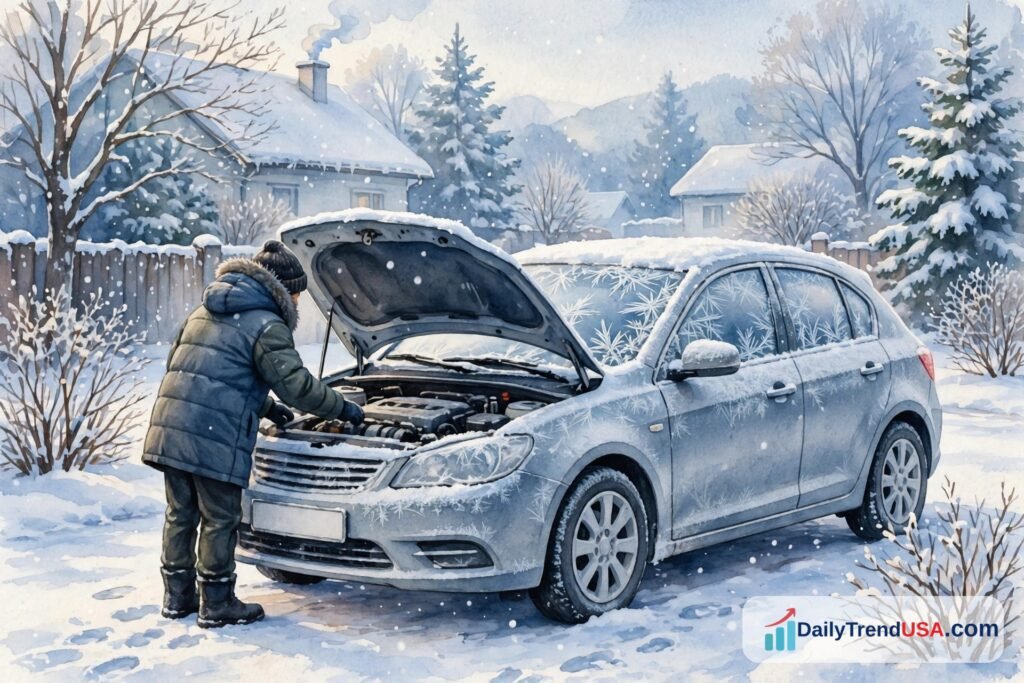
Standfirst: The coldest morning of the year is when a weak car battery finally gives up. A car won’t start in the cold most often because the battery cannot deliver enough power: at 32 degrees Fahrenheit, a battery loses about 30 percent of its strength, AAA says, and the engine needs more power to turn over at the same time. The good news is that the warning signs show up days or weeks before the failure, and a few checks now can keep the car starting all winter.
Key facts
| Fact | Detail |
|---|---|
| Main cause | A weak or aging battery causes most winter no-starts |
| Cold effect | At 32°F, a battery loses about 30 percent of its strength, according to AAA |
| Near zero | A battery can lose up to half its capacity near 0°F |
| Battery life | Most car batteries last 3 to 5 years; test yours after 3 years |
| Warning signs | Slow cranking, dim or flickering lights, a clicking sound, the battery light on the dash |
| Prevention | Test the battery annually before winter, clean the terminals, drive 30 minutes weekly |
| After a jump-start | Drive for at least 30 minutes so the alternator can recharge the battery |
| Electric cars | Precondition the battery while plugged in; use a Level 2 charger |
Why cold weather kills batteries
A conventional 12-volt car battery makes electricity through a chemical reaction, and cold slows that reaction down. At the same time, a cold engine is harder to turn over: the oil is thicker, the parts are stiffer, and the starter needs more power. The battery gets squeezed from both sides. It can deliver less, and the car asks for more.
A healthy battery handles that squeeze. A battery that is already three or four years old often cannot. AAA notes that heat does most of the damage to a battery over its life, and the weakness only shows up when the cold arrives and more power is needed. That is why a battery can seem fine in October and fail on the first freezing morning in December.
Most batteries last three to five years. If yours is older than three, have it tested before winter, not on the coldest morning of the year. Most auto parts stores will test a battery for free in about five minutes, and a test can catch a weak battery before it dies entirely.
Read the symptoms before you call for help
The sound the car makes when it will not start tells you a lot. Learn the three common patterns, because each one points to a different problem.
Rapid clicking when you turn the key usually means the battery does not have enough power to engage the starter. The starter tries, fails, and tries again, and each try makes the same click. Check the battery terminals first, then jump-start the car.
Slow, heavy cranking means the engine is turning over, but sluggishly, as if it is struggling through thick oil. That points to a weak battery, or to oil that is too thick for the cold. Check the oil grade in the owner’s manual, and test the battery.
An engine that cranks at normal speed but never fires is a different problem. The battery is doing its job, but the engine is not catching. That points to fuel, sensors, or, on a diesel, glow plugs and gelled fuel, and it usually needs a mechanic.
Other warning signs show up before the failure. Headlights and interior lights that are dimmer than usual, or that dim while idling and brighten when you accelerate, mean the battery is not supplying steady power. A battery light on the dashboard is a direct warning. A battery case that is swollen, cracked, or leaking is a warning too, and it should be replaced, not jumped.
What to check first on a cold morning
Start with the terminals. Corroded battery terminals can keep the battery from charging properly, and they are the cheapest fix in the car. Look for a white or greenish crust around the posts. If you see buildup, disconnect the negative cable first, clean both terminals with a wire brush and a paste of baking soda and water, then reconnect the negative cable last. Wear gloves and eye protection while you work.
Next, turn off everything the battery does not need. Turn off the radio, lights, and other accessories before you shut the car down, so the first thing the battery has to do in the morning is start the engine. AAA’s advice is simple, and it costs nothing.
If the car still will not start, it needs a jump. Use jumper cables correctly, or call roadside assistance. AAA Battery Roadside Service can jump-start a car without towing it, and its technicians will jump or replace a battery on the spot. After a jump-start, drive for at least 30 minutes so the alternator, which powers the vehicle while it is running, can recharge the battery. A short drive to the store will not do it.
Do not keep cranking a car that will not start. Repeated cranking drains the battery further and can flood the engine. Try once or twice, then stop and work through the checks, or call for help.
How to keep the battery alive all winter
A few habits through the season make the difference. Get the battery tested annually before winter, and replace it before it fails if the test says it is weak. Clean the terminals when you see corrosion. Park in a garage if one is available; even a few degrees of warmth helps the battery. If the car sits outside in extreme cold, consider a battery warmer or blanket.
Drive for at least 30 minutes once a week. Repeated short trips drain the battery without giving the alternator a chance to recharge it, and a car that only ever drives five minutes at a time will slowly run its battery down. A healthy battery can usually handle two to three weeks parked, but an older one may go flat in less. If the car will sit, use a battery tender, or drive it for about 30 minutes once or twice a week.
Electric car owners have a different routine. Precondition the battery while the car is still plugged in, so it warms up on wall power instead of battery power. Use a Level 2 charger where possible, since faster charging helps keep the battery warm and ready.
When it is not the battery
If the battery tests fine and the car still struggles, look further. Thick oil is a common winter problem: the owner’s manual lists the right grade for cold weather, and the wrong grade makes the engine harder to turn over. A fuel problem can also stop a start, and on a diesel, gelled fuel and worn glow plugs are the usual cold-weather culprits. A starter that spins without engaging, or a car that cranks fine but never fires, needs a mechanic, not a new battery.
The pattern to remember is simple. A battery older than three years, a slow crank, dim lights, or a clicking sound all point to the battery, and a test will confirm it. Anything else points past the battery, and guessing costs more than testing.
Related reading: For more winter car guides, see how to winterize your car before the first freeze, how to check tire pressure in cold weather, and what to pack in a winter car emergency kit.
Sources
- AAA, “How to Protect Your Car Battery This Winter”: https://www.acg.aaa.com/connect/blogs/5c/auto/how-to-protect-your-car-battery-this-winter
- AAA, “How Cold Weather Impacts Your Battery”: https://mwg.aaa.com/via/car/how-cold-weather-impacts-battery
- Ride and Tech, “Car Battery in Winter: 10 Essential Tips to Avoid Failure”: https://rideandtech.com/blog/car-battery-in-winter/



One Comment