

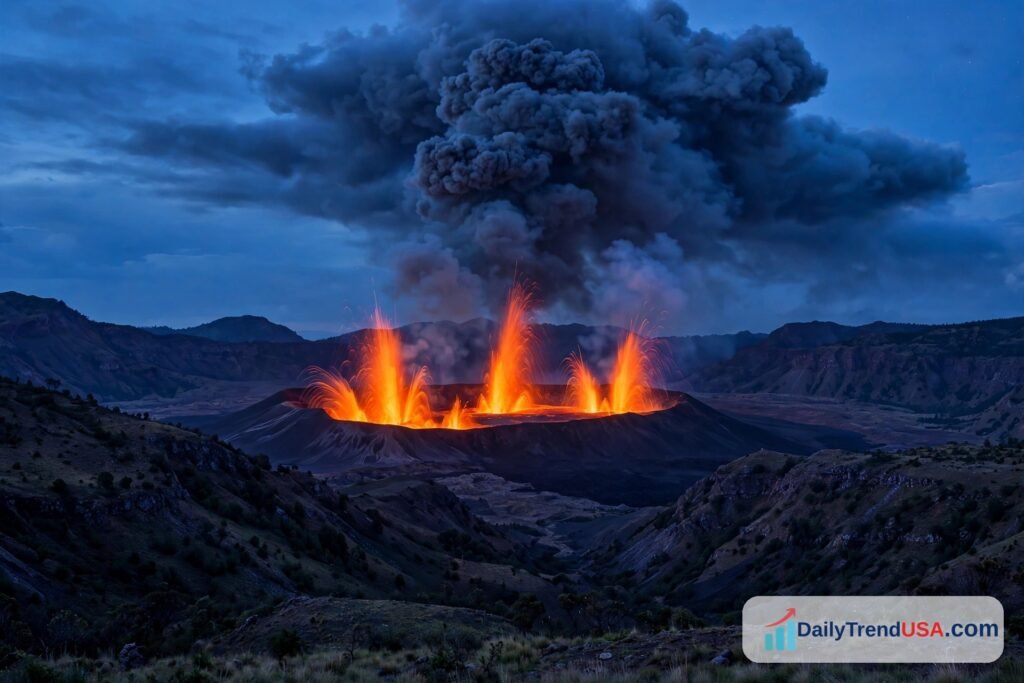
Standfirst: Kilauea’s 56th lava fountaining episode sent lava 660 feet into the air above Halemaʻumaʻu crater on November 5, 2026, then stopped abruptly after about six hours. The eruption is now paused, and the U.S. Geological Survey says the next episode is likely several weeks away. About 8 million cubic yards of lava erupted, and the plume rose to 18,000 feet above sea level.
Key facts
| Fact | Detail |
|---|---|
| Episode | 56th fountaining episode of the eruption that began December 23, 2024 |
| Date and time | November 5, 2026, 12:10 p.m. to 6:01 p.m. HST |
| Duration | About six hours |
| Peak fountain height | About 660 feet (200 meters), from the north vent only |
| Lava erupted | About 8 million cubic yards (6 million cubic meters) |
| Average eruption rate | 260 cubic yards (200 cubic meters) per second |
| Plume height | 18,000 feet (5,500 meters) above sea level |
| Tephra fallout | Mainly southwest, in closed park areas, trace amounts on Highway 11 |
| Current status | Paused; Alert Level ADVISORY, Aviation Code YELLOW, as of November 6 |
| Next episode | Likely several weeks away; no forecast window published |
What we know
- Episode 56 began at 12:10 p.m. HST on November 5, 2026, and ended abruptly at 6:01 p.m. the same day, after about six hours of lava fountaining.
- Fountains peaked at about 660 feet (200 meters) between 1:30 and 2 p.m., and only the north vent produced fountaining, according to the U.S. Geological Survey.
- About 8 million cubic yards of lava erupted, at an average rate of 260 cubic yards per second, and the plume reached 18,000 feet above sea level.
- All vents and lava flows stayed inside Halemaʻumaʻu crater, within Hawaiʻi Volcanoes National Park.
What we don’t know
- The exact date of episode 57. No forecast window has been published; the observatory says only that the next episode is likely several weeks away.
- How tall the fountains in the next episode will be. Fountain heights have varied widely between episodes.
- Whether future activity will stay in the same place. The observatory notes that recent intrusions show the location of eruptive activity could change.
What happened in episode 56
Episode 56 began at 12:10 p.m. Hawaii time on Thursday, November 5, 2026, inside Halemaʻumaʻu crater at the summit of Kilauea, within Hawaiʻi Volcanoes National Park. The Hawaiian Volcano Observatory, part of the U.S. Geological Survey, reported the start in a notice issued at 12:29 p.m. the same day.
At first the fountains reached only about 100 feet, then rose fast. The fountains soon reached 300 feet, and the observatory said heights peaked at about 660 feet, or 200 meters, between 1:30 and 2 p.m. Only the north vent produced fountaining. By 4:43 p.m., the fountain had dropped back to about 330 feet, and it stopped abruptly at 6:01 p.m., after about six hours.
Tiltmeter data indicate that about 8 million cubic yards (6 million cubic meters) of lava erupted, with an average eruption rate of 260 cubic yards (200 cubic meters) per second. The observatory said the peak rate reached about 690 cubic yards per second around 2 p.m. The eruptive plume rose as high as 18,000 feet (5,500 meters) above sea level, according to the National Weather Service and the Washington Volcanic Ash Advisory Center. Tiltmeters recorded 17 microradians of deflation during the episode, a measure of the summit sinking as magma left the chamber below. Tephra fallout went mainly to the southwest, into closed areas of the national park, with trace amounts reaching Highway 11.
How the episodic eruption works
Kilauea has been erupting in episodes since December 23, 2024, from two primary vents, north and south, within Halemaʻumaʻu at the summit. Each episode is a burst of lava fountaining that usually lasts less than 12 hours. Between episodes, the volcano pauses for two or more weeks while the summit slowly reinflates with magma.
The cycle is driven by pressure. Magma rises into the summit chamber and the ground swells. When pressure builds enough, lava breaks out through the vents and fountains into the air. As magma leaves, pressure drops and the ground sinks, which is the deflation scientists measure with tiltmeters. Then the chamber refills, and the ground starts to rise again.
The gaps between episodes have not been steady. Episode 55, on October 17, 2026, lasted about six hours and produced a north vent fountain of about 720 feet, after a pause of almost two months following episode 54 on August 25. Episode 56 then arrived 19 days after episode 55. That uneven rhythm has made forecasting harder. In late September and early October, magma moved along a new path below the caldera, and earthquakes and a shallow intrusion changed the pattern scientists had used to predict the next burst. Even so, the forecast was close. The observatory first said fountaining was most likely between November 1 and 7, then revised the window to November 2 to 9. The episode began on November 5, inside that window.
What the pause means
The day after episode 56 ended, the observatory lowered Kilauea’s alert level. At 2:50 p.m. Hawaii time on Friday, November 6, the Volcano Alert Level went from WATCH to ADVISORY, and the Aviation Color Code went from ORANGE to YELLOW. The notice said there had been no eruptive activity since episode 56 ended on November 5.
The pause does not mean the eruption is over. In the daily update issued Saturday, November 7, at 8:24 a.m. Hawaii time, the observatory said the eruption is currently paused after episode 56 fountaining ended on November 5, the summit is reinflating, and the next episode is likely several weeks away.
Signs of refilling were already clear by Saturday morning. The Uēkahuna tiltmeter had recovered 5.1 microradians of inflationary tilt since the end of episode 56, showing the summit rising again as magma returns. Seismic tremor remained elevated, with sporadic spikes that the observatory said suggest gas pistoning cycles in the conduit. No earthquakes were located at the summit in the past day.
Volcanic gas remains a factor during the pause. Between fountaining episodes, the sulfur dioxide emission rate from the summit is typically several thousand tonnes per day. On the morning of November 7, trade winds were carrying volcanic gases southwest toward Kaʻū. Sulfur dioxide reacts in the atmosphere to create vog, or volcanic air pollution, and the observatory notes that it may cause respiratory and other problems at high concentrations.
Visitor and safety information
Anyone planning a trip to see Kilauea should start with the current status, not with a date on a calendar. Episodes last only hours, and the pauses between them last weeks, so a visit planned around one episode can easily miss the next. The observatory publishes daily updates, and the park posts current conditions on its own website.
When fountaining is active, the best views are from the public viewing areas the park keeps open. The eruptive vents sit inside Halemaʻumaʻu crater, in an area closed to the public since early 2008. The observatory warns that tephra on the crater rim is prone to cracking, slumping, and small landslides that sometimes expose hot and molten material. Ground cracks around the caldera can widen without warning, and rockfalls can be made worse by earthquakes.
Tephra is another hazard visitors should know about. The small glassy fragments thrown out by lava fountains include volcanic ash, pumice, scoria, Pele’s hair, and reticulite. Larger pieces fall near the vents, while lighter pieces can drift farther on the wind. The fragments can cause skin, eye, and respiratory irritation. During episode 56, fallout went mainly to the southwest, into closed areas of the park, with trace amounts on Highway 11. Recent lava also stays dangerous after it stops moving, since hot and glassy surfaces can cause serious burns and cuts on contact with unprotected skin. Daily Trend USA has also covered a Southern California king tides flood warning.
What to watch next
The main number to watch is summit tilt. The Uēkahuna tiltmeter measures whether the ground is rising as magma refills the chamber. In past episodes, the observatory has published a forecast window for the next burst once inflation gives it enough to work with. As of November 7, no window had been published for episode 57.
Other signs matter too. Rising seismic tremor, changes in gas output, and glow at the vents can all point to magma moving closer to the surface. The observatory also watches for earthquakes and ground cracks, which can signal that magma is finding a new path. For comparison, episode 55 produced fountains of about 720 feet, taller than episode 56, and the observatory has said that peak fountaining in past episodes typically reaches 500 to 1,500 feet. Episode 56 sits in the middle of that range. For now, the volcano is quiet at the surface and busy underground, with the summit swelling and the chamber refilling. If the pattern holds, the quiet will last several weeks, and then the fountains will return. Daily Trend USA has also covered other Earth science stories, including a study of two giant tears in a tectonic plate beneath Iran and an unusually early weakening of the polar vortex.
Sources
- U.S. Geological Survey, Hawaiian Volcano Observatory Daily Update, November 7, 2026
- Fox Weather, “Hawaii’s Kilauea experiences its 56th eruption episode,” November 6, 2026
- U.S. Geological Survey, Hawaiian Volcano Observatory Volcanic Activity Notice, November 5, 2026 (episode 56 ended)
- U.S. Geological Survey, Hawaiian Volcano Observatory Volcanic Activity Notice, November 6, 2026 (alert level lowered to ADVISORY/YELLOW)
- Fox Weather, “Kilauea on track for another eruption in early November following unusual 55th episode,” October 31, 2026



One Comment