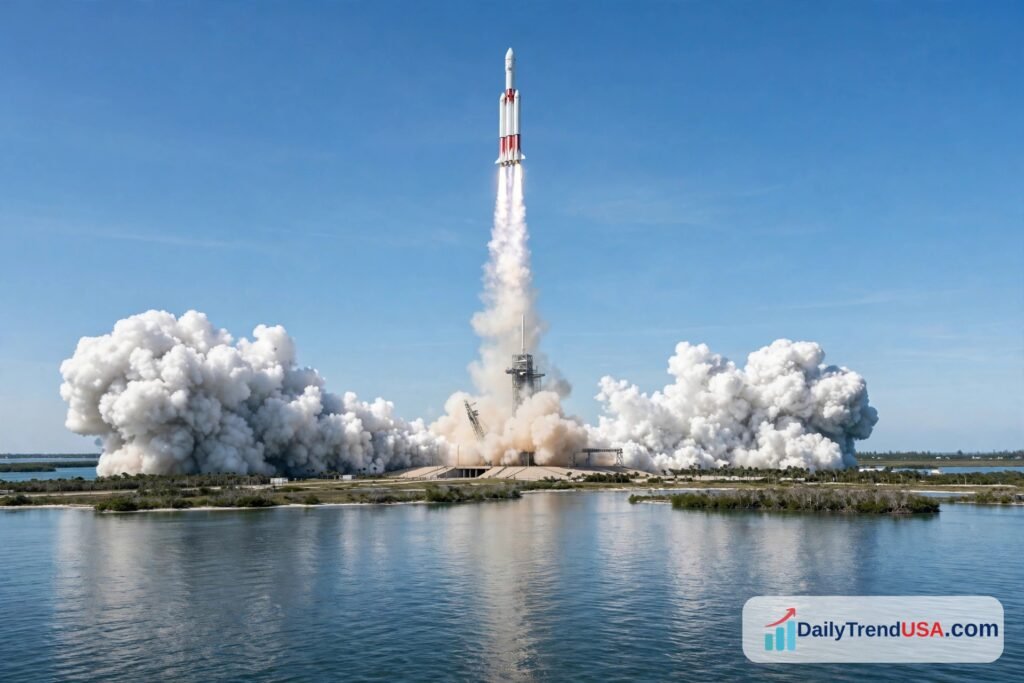
Updated 5:30 p.m. ET, Nov. 15, 2026: A United Launch Alliance Vulcan rocket lifted off at 12:41 p.m. ET on Sunday from Cape Canaveral Space Force Station in Florida, carrying 40 Amazon Leo broadband satellites. About 10 minutes into the flight, the rocket suffered an anomaly and failed to deliver the satellites to orbit, ULA confirmed. All 40 satellites were lost, in the first outright failure of a ULA rocket since the company was formed in 2006.
The mission failed 10 minutes after liftoff
The early part of the flight went as planned. All six solid rocket boosters separated on schedule at 1 minute 45 seconds. The trouble came later, during the Centaur upper stage burn, according to Spaceflight Now. About 50 minutes after liftoff, ULA confirmed the outcome in a statement posted on X.
“Based on data received by our Launch Director, we confirm that the Vulcan vehicle launched from Space Launch Complex 41 suffered an anomaly 10 minutes into the flight and failed to deliver the Amazon mission to orbit,” ULA said. “Today, we did not meet that standard,” the company added, referring to its standard of mission success. ULA said it does not yet have specific data on what went wrong and will work with Amazon and other organizations to find the cause and return to flight as quickly as possible.
Amazon Leo said in a post on X that there is risk with any launch, especially for inaugural missions like this one, and that it believes ULA will learn from the flight. NASA Administrator Jared Isaacman offered assistance if needed, Spaceflight Now reported.
Key facts
| Launch time | 12:41 p.m. ET, Sunday, Nov. 15, 2026 |
| Rocket | Vulcan VC6L, with six solid rocket boosters |
| Payload | 40 Amazon Leo broadband satellites |
| Launch site | Space Launch Complex-41, Cape Canaveral Space Force Station, Florida |
| Booster separation | All six solid rocket boosters separated 1 minute 45 seconds into flight, at 22 miles altitude |
| Grounding | Vulcan had not flown since Feb. 12, 2026, after a booster nozzle problem |
| Outcome | Mission failed about 10 minutes after liftoff; all 40 Amazon Leo satellites lost |
What we know / What we don’t know
What we know: Liftoff happened at 12:41 p.m. ET on Nov. 15, 2026, from Space Launch Complex-41. All six solid rocket boosters separated on schedule. The rocket carried 40 Amazon Leo satellites, the first of 38 Vulcan launches Amazon has booked with ULA. The mission follows two scrubbed attempts on Friday and Saturday.
What we don’t know: What caused the anomaly. ULA said it does not yet have specific data on what went wrong and will work with Amazon and other organizations to find the cause. It is also not yet known when Vulcan will fly again, or when the U.S. Space Force will clear Vulcan again for national security missions, a decision that depends on the investigation.
A launch three days in the making
Sunday’s liftoff came on the third attempt. The first try, on Friday, Nov. 13, was scrubbed while the rocket was being fueled, after ULA found a commodity flow issue with a supplier. The second try, on Saturday, Nov. 14, was scrubbed because of a network communication issue between ground equipment and the launch vehicle, a problem that would have taken longer to fix than the 29-minute launch window allowed.
On Sunday, the window opened at 12:11 p.m. ET. A hold late in the countdown pushed the target to 12:40 p.m., the very end of the window, and ULA cleared the hold in time. The rocket left the pad at 12:41 p.m. ET, according to Florida Today’s live coverage, and climbed on a northeasterly path over the Atlantic, visible along much of the Florida coast. ULA had published a visibility map before the flight showing the path passing several states along the East Coast, so skywatchers well beyond Cape Canaveral had a chance to spot it.
At 1 minute 45 seconds into flight, ULA reported that all six solid rocket boosters had separated from the first stage at an altitude of 22 miles. That moment mattered more than most booster separations, because the boosters were the reason Vulcan had been grounded.
What flew on Sunday
The rocket was a Vulcan VC6L, the most powerful version of the vehicle. It stood 215 feet tall and flew with six Northrop Grumman GEM 63XL solid rocket boosters strapped to its sides, plus two Blue Origin BE-4 engines on its core stage. Each BE-4 produces 550,000 pounds of thrust at sea level, and each booster adds 459,000 pounds. The upper stage, a LEO-optimized Centaur V, is powered by two RL10C-1-1A engines.
The 40 satellites on board are part of Amazon Leo, the broadband constellation Amazon is building following eight earlier Leo deployment missions that flew on ULA’s Atlas V rocket. The satellites are designed to deliver fast, reliable internet to customers beyond the reach of existing networks, and the finished constellation is planned to include more than 3,000 satellites.
The mission is also the first Vulcan flight processed at Amazon’s new Vertical Integration Facility, known as VIF-A, south of the launch pad. The rocket and its launch platform traveled by rail about 2.7 miles north to the pad for the final countdown and fueling.
Why this flight matters
Vulcan had not flown since Feb. 12, 2026, when a booster nozzle suffered a burn-through about 20 seconds after liftoff during the USSF-87 national security mission. It was not the first nozzle problem for the rocket. Nozzle trouble had affected half of Vulcan’s first four flights, starting with the vehicle’s second flight in October 2024.
After the February failure, the Space Force paused national security launches on Vulcan. The investigation into that failure remains open. ULA flew the redesigned nozzle for the first time on Sunday, with all six boosters burning at once, and the Space Force has said it wants to review data from this flight before deciding whether Vulcan flies military missions again. Sunday’s flight was not clean, so the Space Force review now depends on the findings of the new investigation.
The stakes are high for Amazon, too. The company needs scale to make its constellation work. NASASpaceFlight reported before the flight that once these 40 satellites were deployed, the Leo constellation would have 432 satellites in orbit, with 368 in their operational orbit as of early November. That count does not include Sunday’s satellites, which were lost. Amazon needs 578 satellites in a circular orbit at an altitude of 630 km to start initial regional service. In June, Amazon obtained an extension from the Federal Communications Commission for a waiver of the requirement to fly half of its satellites by July 30, 2026, which shows how tight the schedule has been.
Sunday’s launch also matters for the wider launch market. Amazon Leo is a direct competitor to SpaceX’s Starlink in satellite broadband, and Vulcan is one of the few American heavy-lift rockets available to carry its satellites. For more on recent American heavy-lift activity, see our report on the SpaceX Starship Flight 15 launch, where a booster catch attempt was aborted, and our earlier look at how the Artemis II launch disturbed the ionosphere.
What happens next
The next step is the investigation. ULA said it will work closely with Amazon and other organizations to find the cause, determine the appropriate corrective action and return to flight as quickly as possible. ULA also promised full transparency with its customers, who will have visibility into the investigation, and said it will provide further updates when new information becomes available.
The focus now shifts to the Space Force review. The service has said it will use data from this flight, along with ground engineering and testing, to decide how to proceed with Vulcan for national security missions. That decision will shape the schedule for military launches that have been waiting since February, and it now depends on the outcome of the failure investigation.
Amazon’s launch pace is set to continue. The next Leo launch is planned on an Ariane 6 rocket no earlier than Nov. 23, and more Vulcan flights will follow as Amazon works toward the 578 satellites it needs for initial service. Sunday’s flight, after two scrubs and nine months on the ground, ended in failure instead of the clean return both companies needed.
Sources: United Launch Alliance, Vulcan Leo 1 mission page; Florida Today, live updates from Cape Canaveral; NASASpaceFlight, ULA’s Vulcan set to return to flight with first Amazon Leo payload; ULA statement on X, Nov. 15, 2026; Spaceflight Now, ULA suffers first outright failure with loss of Vulcan rocket carrying 40 Amazon Leo satellites.