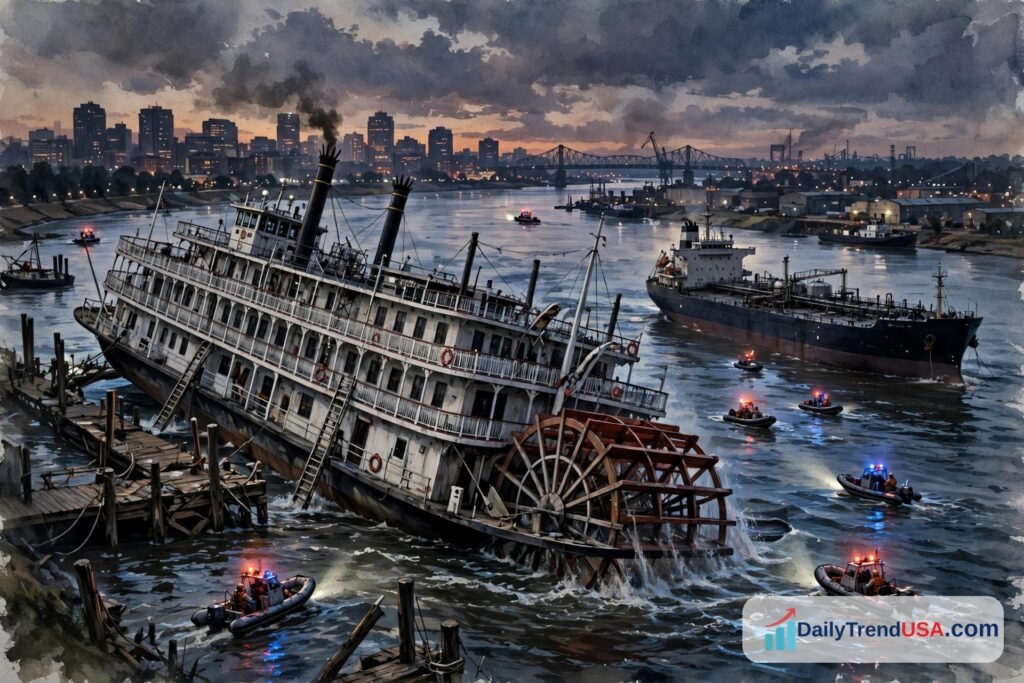
Standfirst: A tanker struck a docked river cruise boat on the Mississippi River in New Orleans on Friday, sending 32 people to hospitals and forcing a rescue that pulled people from the water. The collision happened at about 12:30 p.m. local time, and officials said everyone aboard was accounted for, with no critical injuries and no deaths.
Key facts
- What: The tanker Atlantic Asphalt struck the docked American Heritage riverboat
- When: About 12:30 p.m. local time, Friday, November 13, 2026
- Where: Port of New Orleans, on the Mississippi River, near the Crescent City Connection bridge
- People aboard: About 129 passengers plus crew members; about 180 people in total, according to The Associated Press
- Injuries: 32 people taken to hospitals, none with critical injuries; 30 from the riverboat and two first responders
- Outcome: The riverboat took on water and capsized at the dock; everyone was accounted for; no deaths reported
- River closure: The Coast Guard closed the Mississippi River between mile markers 93 and 96
- Investigation: The National Transportation Safety Board is sending a Go Team, expected to arrive Saturday, November 14; the Coast Guard is also investigating
- Cause: Not yet determined; the mayor said the tanker “lost control” before the crash
- Sources: Port of New Orleans; New Orleans Mayor Helena Moreno; The Associated Press; USA Today; Splash247; gCaptain; WDSU; NBC News
What we know
- The Atlantic Asphalt struck the American Heritage at about 12:30 p.m. local time on Friday, November 13, while the riverboat was docked at the Port of New Orleans.
- About 129 passengers and crew members were aboard; The Associated Press reported about 180 people in total aboard.
- The riverboat took on water and capsized at the dock.
- 32 people were taken to hospitals, none with critical injuries.
- Everyone aboard was accounted for, and no deaths were reported.
- The Coast Guard closed the river between mile markers 93 and 96.
- The NTSB is sending a Go Team to New Orleans, expected to arrive Saturday, November 14.
What we don’t know
- What caused the tanker to lose control. No official finding has been made.
- When the river will fully reopen to traffic.
- When the capsized riverboat will be removed from the dock.
- The full details of the injuries, beyond that none were critical.
How the collision happened
The American Heritage was tied up at the Port of New Orleans on Friday afternoon, finishing an eight-day voyage along the Mississippi River. The paddlewheel riverboat, operated by American Cruise Lines, had docked about two hours earlier and was disembarking passengers near the Port of New Orleans Administration Building, close to the Crescent City Connection bridge.
At about 12:30 p.m. local time, the tanker Atlantic Asphalt struck the riverboat. The tanker is a 525-foot asphalt tanker flagged in the Marshall Islands. Splash247, a maritime news outlet, reported that the 17,764-deadweight-ton vessel was built in 2017. The impact pushed the riverboat against the dock. The riverboat began taking on water and capsized where it was moored.
Port of New Orleans spokesperson Kimberly Curth told USA Today that the collision happened at about 12:30 p.m. local time. She confirmed that the Atlantic Asphalt collided with the American Heritage while the cruise boat was docked at the port.
New Orleans Mayor Helena Moreno said at a Friday afternoon news conference that the tanker “lost control” before the crash. The Coast Guard captain at the scene also said the tanker appeared to lose steering before the impact, according to reporting on the incident. Neither statement is a final finding. The cause remains under investigation.
The rescue on the river
The collision set off a large rescue operation within minutes. The United States Coast Guard, the New Orleans Fire Department, emergency medical crews, Harbor Police and nearby vessels responded to the scene. Early reports said 12 people were in the water. At least two police officers were pulled from the river during the rescue, according to The Associated Press.
Rescue crews moved people from the listing riverboat to shore and to waiting ambulances. The Port of New Orleans called the event “an active and evolving incident” as crews worked through the afternoon. The city set up a hotline for families looking for information about anyone who may have been involved: 504-539-3266.
By Friday evening, officials had a fuller picture. Of the 32 people taken to hospitals, 30 were from the American Heritage and two were first responders, according to Cruise Industry News reporting on the officials’ briefing. No one was reported missing, and no deaths were reported.
Mayor Moreno summed up the outcome at the news conference, calling it “a miracle on the Mississippi.” USA Today noted in its live coverage that “incredibly, nobody was killed by this major collision.”
What officials confirmed on Friday
The mayor’s Friday afternoon news conference gave the first confirmed injury count. Moreno said crews transported 32 people from the cruise boat to hospitals to be treated for unspecified injuries. None, she said, had suffered critical injuries, and everyone had been accounted for. “At this moment, the information that we have, we have zero people unaccounted for,” she said.
That confirmation ended hours of uncertainty. Earlier in the day, the Port of New Orleans had said the number of injuries and the cause of the collision had not yet been confirmed. News outlets reported a range of figures through the afternoon, from at least eight people taken to hospitals to more than a dozen. The mayor’s briefing settled the count at 32, with none critical.
President Donald Trump praised the first responders. The Coast Guard closed a three-mile stretch of the Mississippi River, between mile markers 93 and 96, while emergency operations were under way. The Coast Guard said it would work with salvage teams to remove the American Heritage and get the river reopened as soon as possible. No reopening time had been given by Friday evening.
The investigation ahead
The National Transportation Safety Board said it would send a Go Team to New Orleans to investigate the collision. The board said in a post on X early Friday evening that it expected the team to arrive on Saturday. The Coast Guard is also investigating and said it would open a Marine Board of Investigation into the cause.
Getting investigators to New Orleans was not simple. The Associated Press reported that NTSB investigators were initially unable to reach the city because nationwide flight disruptions had grounded air travel. The Federal Aviation Administration had ordered a nationwide ground stop on Friday after air traffic control communications problems, and the stop lasted more than four hours. Our report on the FAA ground stop explains what happened and why flights were halted.
Investigators will look at what made the tanker lose control. Reports of a steering failure remain preliminary. Martin Davies, a maritime law expert at Tulane University, said it was too early to establish the cause. The investigation will also cover how the riverboat was moored, what warnings were given, and how the rescue was carried out.
A difficult week for American travel and technology
The riverboat collision came at the end of a rough stretch for American infrastructure. On Thursday, Microsoft’s global service disruption began, hitting Outlook, Teams and other services for millions of users. The outage stretched into Friday before services began recovering. Our report on the Microsoft Outlook outage has the details.
On Friday, the FAA ground stop halted departing flights across the country for more than four hours, the first nationwide stop since January 2023. The stop delayed the NTSB team heading to New Orleans and left airlines dealing with cancellations into the weekend.
Officials have said there is no sign the three events are connected. The Microsoft outage was a technical failure, the FAA stop came from a communications problem in air traffic control, and the riverboat collision is under investigation as a maritime accident. Still, the three events landed within about 48 hours, and each one touched something Americans rely on every day: email, air travel, and now a river cruise.
What happens next
The NTSB Go Team is expected to arrive in New Orleans on Saturday, November 14. The Coast Guard’s Marine Board of Investigation will run alongside the NTSB work. Salvage teams will work to remove the American Heritage from the dock, and the Coast Guard will decide when the closed stretch of river can reopen.
The 32 people taken to hospitals are expected to recover, since none of the injuries was reported as critical. The city hotline remains open for families seeking information. American Cruise Lines has not yet said when the riverboat will return to service, or what happens to the passengers whose voyage ended at the dock.
This story will be updated as the investigation develops.
Sources
- Port of New Orleans, statement via spokesperson Kimberly Curth to USA Today, November 13, 2026 (primary source read directly): usatoday.com
- New Orleans Mayor Helena Moreno, Friday afternoon news conference, November 13, 2026, as reported by USA Today and The Associated Press
- The Associated Press, reporting on the collision, November 13, 2026 (180 people aboard, all survived; 32 to hospitals, none critical; NTSB travel delayed by flight disruptions)
- Splash247, “Tanker sinks river cruise ship in New Orleans collision,” November 14, 2026: splash247.com
- gCaptain, November 13, 2026 (riverboat confirmed capsized at dock)
- WDSU, NBC News and Cruise Industry News, November 13, 2026 (injury breakdown: 30 from the riverboat, two first responders)