

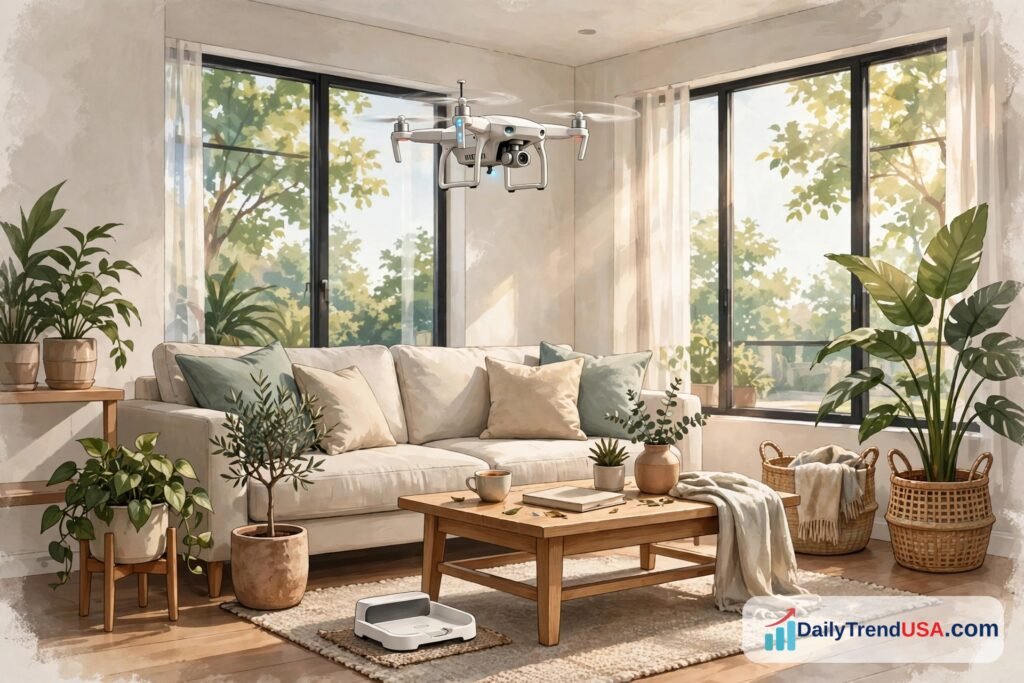
Standfirst: Amazon’s Ring announced on Tuesday, November 10, 2026, that it is launching a new line of security robots, led by a $249.99 flying indoor camera called the Ring Drone Cam. The drone is set to ship in the United States on January 27, 2027, but it still needs authorization from the Federal Communications Commission before Ring can sell it. A second device, the $999.99 Ring Rover Cam for businesses, starts shipping December 16, 2026.
What we know / What we don’t know
What we know:
- Ring announced Ring Robotics on November 10, 2026, calling it “a new category of autonomous, mobile security,” in an announcement on Amazon’s own news site.
- The Ring Drone Cam is a flying indoor security camera that weighs 165 grams (0.36 pounds). It records in 2K video with a 148-degree field of view and can rotate 360 degrees.
- The drone can fly preset routes on a schedule, be sent out on demand, or fly on its own to check a spot when a Ring camera, sensor, or alarm is triggered. Both devices run on Ring’s AI Pilot system, which maps a space, suggests patrol points, and steers around obstacles.
- The Ring Rover Cam is a wheeled security robot for businesses. It streams and records in up to 4K video and has a periscope camera that extends up to 4 feet.
- The Drone Cam costs $249.99 and ships January 27, 2027. The Rover Cam costs $999.99 and ships December 16, 2026. A compatible Ring Protect plan is required for scheduled flights and patrols and for reviewing the Rover Cam’s recorded video.
- The Drone Cam has not yet received the required authorization from the Federal Communications Commission. Ring says the device cannot be offered for sale or lease until that authorization is obtained. For now, Ring is only taking email sign-ups for updates.
- Videos from both devices are protected by Ring’s Throw Away the Key encryption, which Ring calls its strongest default encryption yet.
What we don’t know:
- Ring has not said when the Federal Communications Commission will authorize the Drone Cam, so the January 27 ship date could still move.
- Ring has not announced the monthly cost of the Ring Protect plan that scheduled flights require.
- Reports differ on flight time: Amazon puts it at about eight to 10 minutes per charge, according to Engadget, while WIRED reported five to eight minutes.
- Ring has not said whether the Drone Cam will be sold outside the United States, or when.
A flying camera that patrols your home
The Drone Cam is built around a simple idea: a fixed camera can only see one room, but a flying camera can check the whole house. Ring says the drone stays in its dock, powered down with its camera off, until a flight is triggered. Then it lifts off and flies a route you set in advance, or to a spot you tap on a map in the Ring app. When a Ring camera, sensor, or alarm goes off, the drone can fly to a preset patrol point on its own to investigate.
The drone carries a 2K camera on the front and a 1080p camera underneath, with LED lights for night flights. Setup starts with a walk-through: carry the drone through your home, and AI Pilot turns what it sees into a floor plan and suggests patrol points. Flights are short: Amazon puts battery life at about eight to 10 minutes, and when the battery runs low or the drone loses Wi-Fi, it lands or returns to its dock. Eight minutes of charging gives about one minute of flight time, according to Engadget.
The Rover Cam is built for businesses
The second device is a ground robot for shops, warehouses, and offices. The Rover Cam looks much like Amazon’s earlier Astro robot, and that is no accident. Ring says the Rover was inspired by feedback from Astro customers who said the feature they loved most was roving security. The business version of Astro cost $2,350 and was discontinued in 2024. The Rover is a purpose-built security robot at less than half that price, available to preorder now.
The Rover can be sent to any room or saved patrol point with a tap, and it performs a 360-degree scan when it arrives. Its periscope camera extends up to 4 feet so it can see over counters and shelving. It can run scheduled patrols after closing time, investigate when a sensor trips at 2 a.m., and stream video to your phone while it moves. A built-in siren and a light tower make it clear the space is protected, and two-way audio lets you speak to anyone it finds in real time.
Why this took Ring nearly 10 years
This is not Ring’s first try at a flying camera. Founder Jamie Siminoff says he had the idea in 2016, before Amazon bought Ring in 2018. Ring showed the Always Home Cam in 2020 and announced a drone in 2021, then boxed up units that never shipped because, in Siminoff’s words, they “just didn’t work well enough.” Another attempt stalled in 2025.
The problem was a chain reaction. Each edge case meant adding more sensors, which needed more computing power, more power, and bigger batteries. The extra weight raised safety concerns and led to larger shrouds that hurt flight performance. Doing all of that in one device would have pushed the retail price past $5,000, Siminoff said. What changed is where the thinking happens: the new Drone Cam sends video to the cloud, where AI Pilot decides where to go. Moving the intelligence off the device let Ring cut the weight and the price. Siminoff summed it up in the announcement: “For years, customers told us they wanted eyes in the places a fixed camera couldn’t reach, and peace of mind in the spots they’d never want one. The honest answer wasn’t more cameras; it meant reimagining what a security device could be. That kind of invention is hard, and it takes time. But we kept at it until we got it right, and that’s Ring Robotics.”
Privacy is the question that will follow it
A camera that flies around inside a home will draw privacy questions, and Ring answers them in its announcement. The company says privacy is the default, not a setting. The drone powers down in its dock, camera off, and only records once a flight is triggered. The Rover’s Sleep Mode retracts its periscope and switches off its microphone. Both devices have LED indicators that show when they are recording, and both are designed to be seen and heard: the drone’s propellers are loud, and the Rover’s light tower is bright. Videos from both are protected by Throw Away the Key encryption, which Ring describes as its strongest default encryption yet.
Still, the privacy debate will not end with an announcement. The drone sends video to Ring’s servers so AI Pilot can steer it, which means the device depends on the cloud to work at all. It cannot fly without Wi-Fi, and it will not leave your home, since it needs your network to operate. People who want a flying camera will have to weigh that trade-off: a device that can check any room, but only by sending what it sees to the cloud.
What it costs and when you can get one
The Ring Drone Cam costs $249.99 and is set to ship in the United States on January 27, 2027. But that date depends on the Federal Communications Commission. Ring states plainly on its announcement page that the device “has not been authorized as required by the rules of the Federal Communications Commission” and “is not, and may not be, offered for sale or lease, or sold or leased, until authorization is obtained.” Until that clearance comes through, the only step available is signing up for email updates.
The Ring Rover Cam costs $999.99 and ships December 16, 2026. It is available to preorder now. Both devices need a compatible Ring Protect plan for scheduled flights and patrols and for reviewing the Rover’s recorded video, and Ring has not said what that plan will cost. The business robot is real and orderable today, while the home drone is a price, a date, and a promise that still needs a federal sign-off. If the authorization lands on time, the drone arrives in late January. If it slips, the date slips with it.
What happens next
The next milestone is the Rover Cam’s ship date, December 16, 2026, when the first Ring Robotics devices reach customers and the first real-world reports of the robot patrolling a shop floor or a warehouse appear. The Drone Cam follows on January 27, 2027, if the commission authorizes it in time. The home drone still has one federal hurdle left.
Home safety gear is only part of keeping a house protected. Carbon monoxide alarms, symptoms, and safety steps every home should know cover a risk a camera cannot see. For the devices already in your home, how to keep your phone battery alive in cold weather explains what cold does to batteries. And for how AI is reaching more consumer products, Instagram’s AI age detection is now rolling out to teens worldwide.
Sources: Amazon, “Ring announces Ring Robotics, ushering in a new era of security” (November 10, 2026), aboutamazon.com; Reuters, “Amazon’s Ring launches flying camera, autonomous security robot” (November 10, 2026), reuters.com; Engadget, “Amazon finally launches the $250 Ring Drone Cam and also the Ring Rover Cam” (November 10, 2026), engadget.com.


One Comment